
Baking Tips · 10 min read · Updated November 15, 2026
Baking by Weight: Cups to Grams and How to Use a Kitchen Scale
A cup of flour can land heavy or light depending on how you fill it. Weigh it instead, and the same recipe turns out the same way every time you bake it.
Dip a measuring cup into a bag of flour, level it with a knife, and you have a cup. Spoon the flour in gently and level it again, and you have a different cup. The words in the recipe stayed the same, yet the amount in your bowl did not. That gap explains why a cake can bake up dense one week and dry the next, and why a bread dough feels slack on Sunday and stiff on Tuesday. A scale takes the guessing out, because a gram of flour is a gram no matter how tightly it sits.
King Arthur Baking recommends weighing ingredients with a digital scale for the best results, and its ingredient weight chart lists a cup of all-purpose flour at 120 grams, or 4 1/4 ounces. Once you start from a number like that, your baking stops depending on your scooping style.
Why does weighing beat measuring cups?
Volume tells you how much space an ingredient fills, and dry ingredients fill space unevenly. Flour settles in the bag, fluffs up under a spoon and packs down under a scoop. Brown sugar can be pressed hard into the cup or dropped in loosely. Chopped walnuts leave air pockets that change with the size of each piece. Weight ignores all of it.
You also wash fewer dishes. With a scale, one bowl sits on the platform and everything goes into it. There is no stack of sticky measuring cups, no honey clinging to a spoon, and no flour dust spreading across the counter while you level a cup with a knife.
Weight scales up and down cleanly, too. Say a recipe gives 240 grams of flour and you want two thirds of the batch. You multiply once and weigh 160 grams. Try the same thing in cups and you end up hunting for two thirds of a cup and then guessing at the leftover tablespoons.
Consistency makes your own notes worth keeping. When you write "add 20 g more water next time" in the margin, that note means exactly the same thing the next time you bake. A note that says "a little more flour" means whatever your hand decides on the day.
How do you convert a cups recipe to grams?
Start from a chart built ingredient by ingredient, not from one generic conversion. A cup of water and a cup of flour do not weigh the same, so a single "grams per cup" figure is wrong for nearly everything in your pantry. The chart below is copied from King Arthur Baking's ingredient weight chart. Notice how far the numbers move: a cup of all-purpose flour weighs 120 grams, a cup of granulated sugar 198 grams, and a cup of packed brown sugar 213 grams.
| Ingredient | Volume | Ounces | Grams |
|---|---|---|---|
| All-purpose flour | 1 cup | 4 1/4 | 120 |
| Bread flour | 1 cup | 4 1/4 | 120 |
| Unbleached cake flour | 1 cup | 4 1/4 | 120 |
| Whole wheat flour (premium 100%) | 1 cup | 4 | 113 |
| Pastry flour | 1 cup | 3 3/4 | 106 |
| Almond flour | 1 cup | 3 3/8 | 96 |
| Semolina flour | 1 cup | 5 3/4 | 163 |
| Granulated white sugar | 1 cup | 7 | 198 |
| Brown sugar (packed) | 1 cup | 7 1/2 | 213 |
| Confectioners' sugar (unsifted) | 1 cup | 4 | 113 |
| Turbinado sugar | 1 cup | 6 3/8 | 180 |
| Butter | 8 tablespoons (1/2 cup) | 4 | 113 |
| Vegetable oil | 1 cup | 7 | 198 |
| Milk | 1 cup | 8 | 227 |
| Water | 1 cup | 8 | 227 |
| Buttermilk | 1 cup | 8 | 227 |
| Heavy cream | 1 cup | 8 | 227 |
| Sour cream | 1 cup | 8 | 227 |
| Yogurt | 1 cup | 8 | 227 |
| Honey | 1 tablespoon | 3/4 | 21 |
| Maple syrup | 1/2 cup | 5 1/2 | 156 |
| Molasses | 1/4 cup | 3 | 85 |
| Egg (fresh) | 1 large | 1 3/4 | 50 |
| Cocoa (unsweetened) | 1/2 cup | 1 1/2 | 42 |
| Chocolate chips | 1 cup | 6 | 170 |
| Cornstarch | 1/4 cup | 1 | 28 |
| Oats (old-fashioned or quick) | 1 cup | 3 1/8 | 89 |
| Raisins (loose) | 1 cup | 5 1/4 | 149 |
| Walnuts (chopped) | 1 cup | 4 | 113 |
| Peanut butter | 1/2 cup | 4 3/4 | 135 |
To convert a recipe, work through it line by line and write the gram figure next to each ingredient. Multiply when the recipe asks for more or less than the chart's volume. Two and a half cups of all-purpose flour becomes 300 grams. Three quarters of a cup of granulated sugar works out to about 149 grams. Round to the nearest gram and move on, since a fraction of a gram makes no difference in a cake.
Watch the volume column before you multiply. Butter appears in the chart as 8 tablespoons, honey as a single tablespoon, maple syrup as half a cup and molasses as a quarter cup. Scale from the amount shown rather than assuming every row means a full cup, or your honey cake will carry four times the honey you meant.
Eggs are worth weighing as well. The chart puts a large fresh egg at 50 grams, a large white at 30 to 35 grams and a large yolk at 14 grams. Your eggs will not all match that, so cracking them into a bowl on the scale lets you hit the amount the recipe expects. Pastry and custard recipes that call for a certain number of yolks become far more predictable this way.
One last rule: when a recipe author already gives grams, use their grams. They measured their own flour their own way, and their weights are the recipe. Convert from cups only when cups are all you have.
How do you use the tare button on an Escali scale?
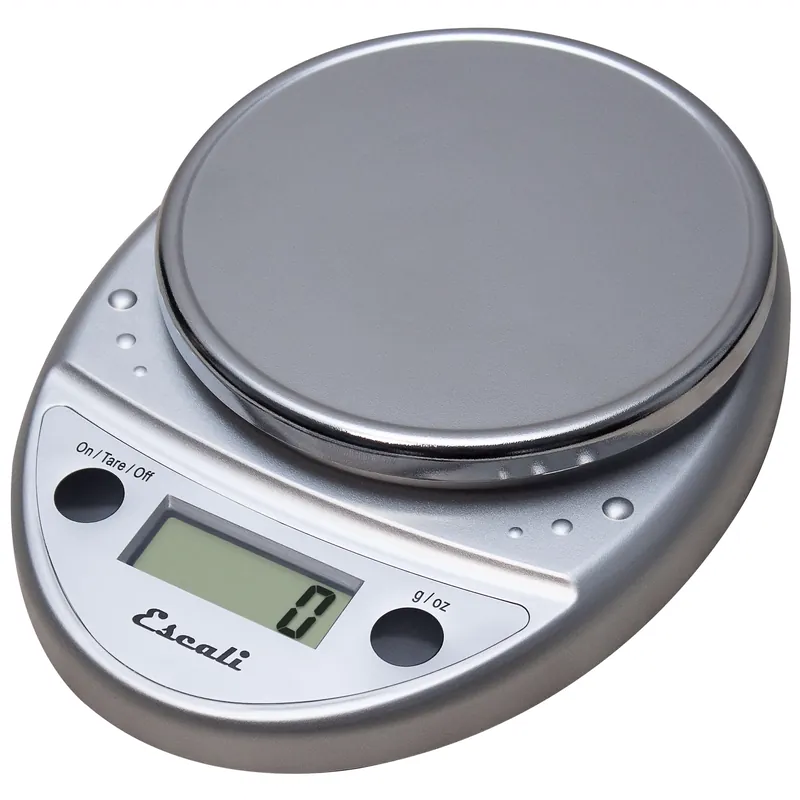
Tare, sometimes labeled zero, resets the display to zero with whatever already sits on the platform. On a baking day it does two jobs. It removes the weight of your bowl, and it lets you add ingredient after ingredient to that same bowl without doing any subtraction. Our Primo digital scale describes the feature as resetting the scale to zero to measure multiple items or subtract the weight of a container, and you will see the same function across most Escali kitchen scales.
Here is the add-and-zero method for a one-bowl batter:
- Turn the scale on with nothing on the platform, then set your empty bowl in the center.
- Press tare. The display returns to zero.
- Add your first ingredient until the display shows the target weight.
- Press tare again. You are back at zero with the first ingredient still in the bowl.
- Add the next ingredient, tare, and repeat down the recipe.
Go slowly near each target. If you overshoot a dry ingredient that is still sitting on top, spoon the extra out before you press tare. Once two ingredients have mixed, you cannot pull one back out, so pour the last few grams of anything gently. A habit that helps: put dry ingredients in first, then fats, then liquids, so a spill of milk never lands in a pile of sugar you still need to measure.
Keep an eye on automatic shut-off while you work. The Primo turns itself off after four minutes of inactivity, and the Telero, Nutro, T115S and Vera switch off after five. If a phone call pulls you away mid-recipe, jot down which ingredients are already in the bowl. That way a dark display never leaves you guessing whether the baking soda went in.
You can also note the empty bowl's weight once, before your first tare, and keep it on a sticky label under the bowl. Later, if you want to divide a dough evenly, you weigh the full bowl, subtract that number and split what is left.
Should you weigh liquids too?
Yes, and for a simple reason: per King Arthur Baking's chart, a cup of water, milk, buttermilk, heavy cream, sour cream or yogurt each weighs 8 ounces, or 227 grams. Pouring milk straight into the bowl on the scale is faster than filling a liquid cup at eye level, and you skip the cup entirely.
Not every liquid weighs the same per cup. Vegetable oil comes in lighter, at 7 ounces or 198 grams per cup on the same chart, even though it fills the cup just as water does. That difference is the reason ounces on a scale and fluid ounces on a measuring cup are not interchangeable. One measures weight, the other measures volume.
Sticky liquids show the biggest gain. The chart lists honey at 21 grams per tablespoon, maple syrup at 156 grams per half cup and molasses at 85 grams per quarter cup. Pour them directly into the batter until the display reaches the number. Nothing stays behind in a measuring cup, so the amount you weighed is the amount you used.
Which Escali scales show fluid ounces and milliliters?
Several of our scales offer liquid units alongside weight. The Arti glass scale measures in grams, pounds, ounces, fluid ounces and milliliters. Our Nutro covers the same five units, and the T115S measures liquids in fluid ounces and milliliters and dry ingredients in grams, ounces and pounds plus ounces. A scale can only sense weight, so any volume it shows is worked out from that weight. With water and thin, water-like liquids such as milk, the liquid setting is handy. For oil, honey or syrup, weigh in grams and use the chart.
The Pana V136 volume scale takes that idea further. It comes preprogrammed with ingredient codes and a laminated code list, so you enter the code for an ingredient and read a volume. That helps when you bake from an old family card written only in cups and want to see what a "cup" of a particular ingredient looks like on the platform.
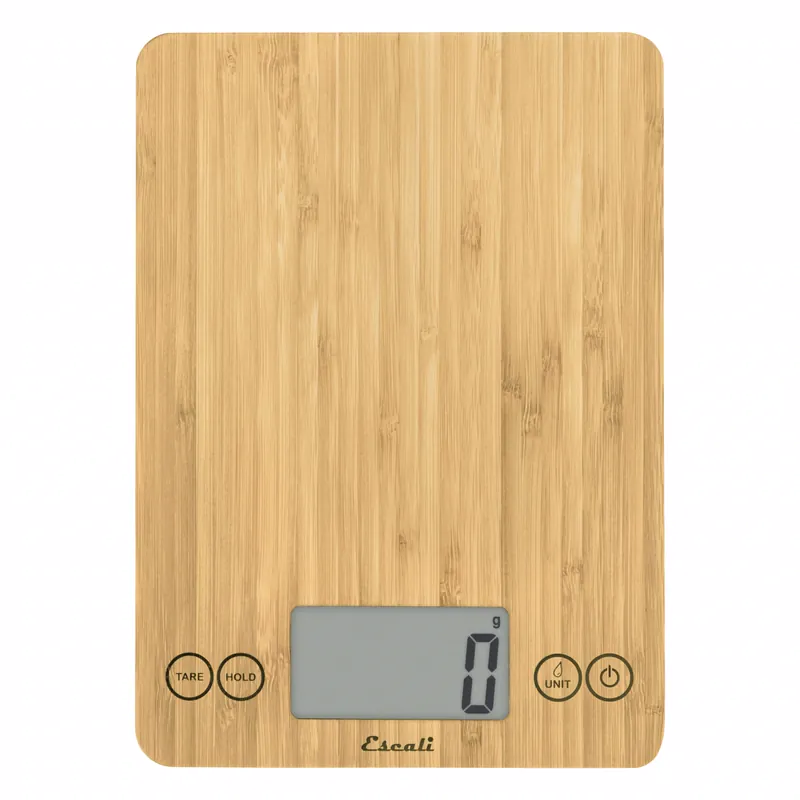
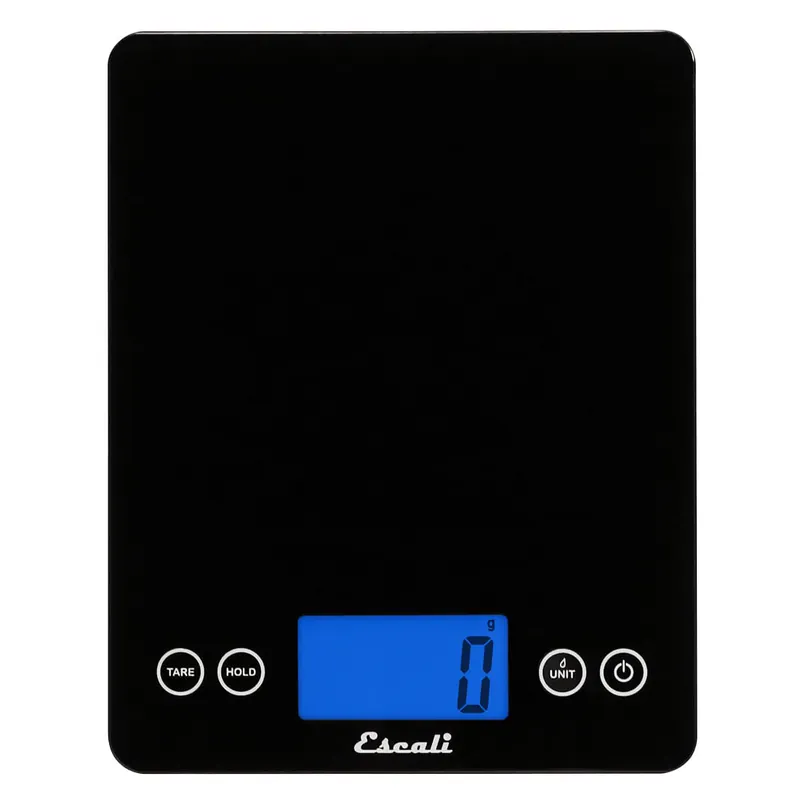
Escali Arti Glass Food Scale
A tempered glass top with a large touch screen that keeps the reading on display after you lift the bowl.
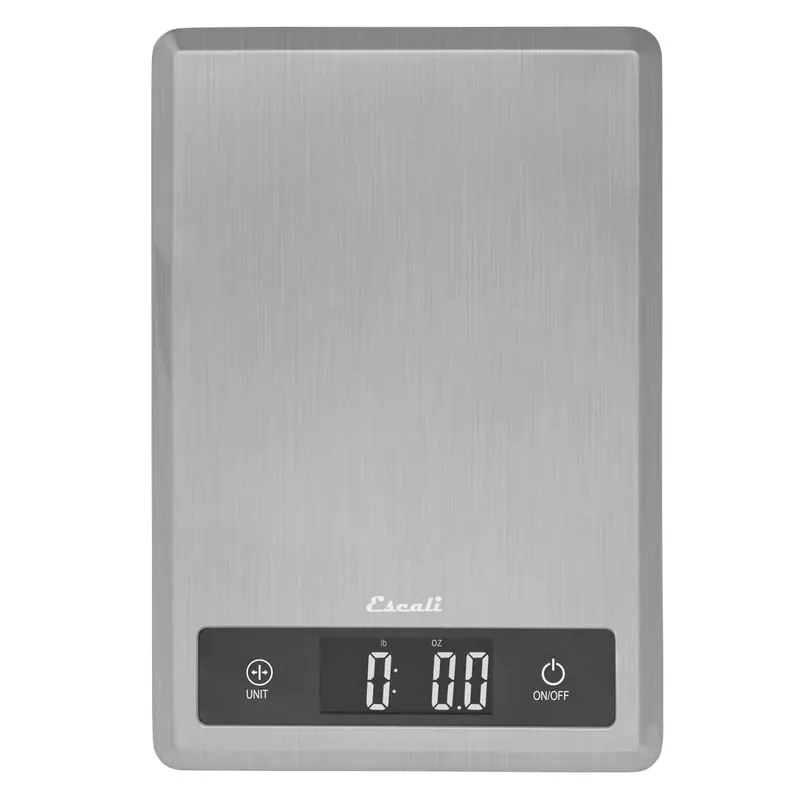
Escali T115S Ultra Thin Scale
A thin glass-top scale with white-on-black digits and touch controls that leave nothing to trap crumbs.
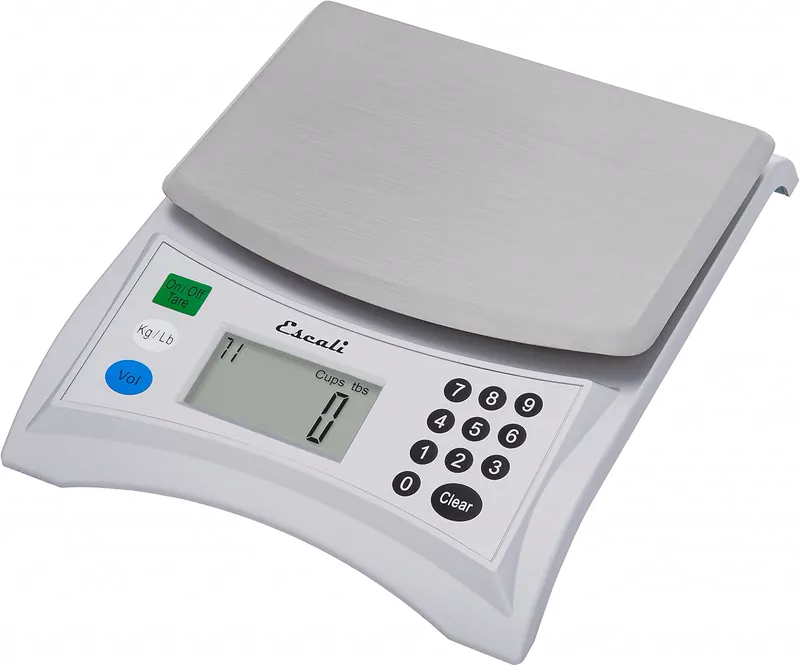
Escali Pana V136 Volume Scale
Turns weight into volume for preprogrammed ingredients, with a laminated code list in the box.
What about small amounts like salt, yeast and baking powder?
Teaspoons and tablespoons hide surprises of their own, and salt is the clearest case. The King Arthur Baking chart lists a tablespoon of table salt at 18 grams, a tablespoon of Morton's kosher salt at 16 grams and a tablespoon of Diamond Crystal kosher salt at 8 grams. Same spoon, same level top, and one brand delivers half the salt of the other. If a recipe developed with one box calls for a tablespoon and you reach for the other, your bread can end up with double or half the salt the author intended. Weigh the salt and the brand stops mattering.
| Ingredient | Volume | Grams |
|---|---|---|
| Baking powder | 1 teaspoon | 4 |
| Baking soda | 1/2 teaspoon | 3 |
| Instant yeast | 2 1/4 teaspoons | 7 |
| Salt (table) | 1 tablespoon | 18 |
| Salt (Morton's kosher) | 1 tablespoon | 16 |
| Salt (Diamond Crystal kosher) | 1 tablespoon | 8 |
| Egg yolk | 1 large | 14 |
Resolution matters at this end of the chart. A scale that reads in whole grams shows 3 grams of baking soda as 3, but the true amount can sit a fraction of a gram either side, and on a 3-gram measure that fraction is a real share. For leaveners in a single batch, a level measuring spoon is a fair match for the chart. Weighing pays off most on flour, sugar, butter and salt, where volume drifts the most. Professional bakers push the idea further with baker's percentages, where every ingredient is written as a share of the flour weight, a habit set out in our ten professional baking secrets.
When you bake in bigger batches, or you want a dedicated scale for the small stuff, the Vera PR2000S is our compact high-precision model. It carries a 4.4 lb capacity, a removable stainless steel plate that goes in the dishwasher and a backlit display that stays readable under kitchen lighting. Pair it with a larger scale for the main bowl and you can weigh yeast and salt on the side without moving the batter.
How do you choose an Escali baking scale?
Start with capacity, and count the bowl. A heavy glass or ceramic mixing bowl takes up part of the scale's capacity before any flour goes in. Weigh your largest bowl on its own, subtract that from the capacity, and you know how big a batch the scale can really handle. The ArtiXL offers 22 lb (10 kg), the Nutro and Arti 15 lb, the Pana V136 13 lb, and the Primo and T115S 11 lb. If you are comparing the whole range on capacity, increments and power, the complete buyer's guide to kitchen scales lines them up side by side.
Next, look at increments. The Primo reads in 0.05 oz (1 g) steps, the ArtiXL in 0.1 oz (1 g) steps, and the Telero can weigh in steps of 1 gram, 0.01 ounce or 0.001 pound for finer work. For most baking, whole grams are plenty.
Platform size decides if you can read the display at all. A wide mixing bowl that overhangs a small platform can cover the screen just when you need it. The Telero has a large platform so its display is not blocked when you weigh large items, and the Arti and Nutro both offer display hold, which keeps the reading on screen after you lift an oversized item off.
Then think about cleanup, because flour and batter find every gap. The Primo, Telero and Vera have sealed control panels that guard against spills. On the ArtiXL, Nutro and T115S you get touch-sensitive controls on a smooth glass surface that wipes clean, and the Arti has a tempered glass top with a touch-sensitive screen.
| Scale | Capacity | Increments | Platform and controls | Liquid measuring | Price |
|---|---|---|---|---|---|
| Primo | 11 lb (5,000 g) | 0.05 oz (1 g) | Sealed control panel, two buttons | — | $25.00 |
| Arti | 15 lb | — | Tempered glass, touch screen, display hold | fl oz, ml | $34.95 |
| ArtiXL | 22 lb (10 kg) | 0.1 oz (1 g) | Glass surface, touch controls | Liquid and dry | $34.69 |
| Telero | — | 1 g, 0.01 oz, 0.001 lb | Large platform, sealed control panel | Liquid and dry | $24.95 |
| Nutro | 15 lb (7,000 g) | — | Stainless platform, touch controls on glass, display hold | fl oz, ml | $49.95 |
| T115S | 11 lb | — | Ultra thin, touch controls on glass, reverse LCD | fl oz, ml | $45.04 |
| Vera PR2000S | 4.4 lb | — | Removable stainless plate, sealed control panel | Liquid and dry | $31.34 |
| Pana V136 | 13 lb | — | Ingredient codes, code list included | Volume readings | $64.66 |
If you bake bread and big batches, capacity comes first. For cookies and cakes mixed in one bowl, a scale like the Primo at $25.00 covers the job with simple two-button operation. A household that bakes and weighs portions at the same counter gets the most out of liquid units and display hold.
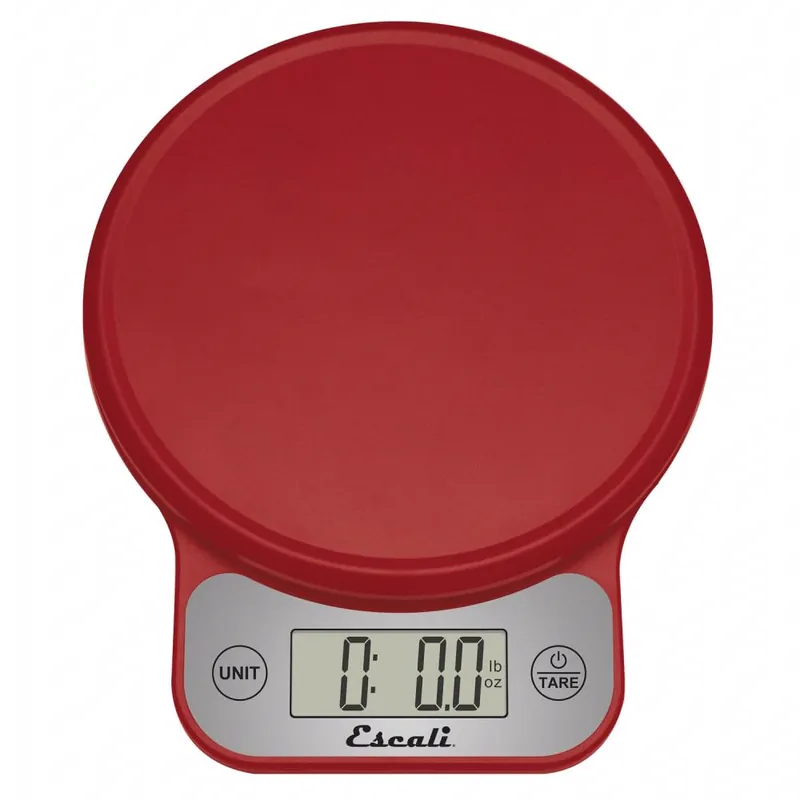
Escali Primo Digital Food Scale
A sealed two-button scale with a rounded body that wipes clean, weighing up to 11 lb in 1 g steps.
Escali Telero Food Scale
A broad platform keeps the display readable under a large mixing bowl, and the sealed panel keeps flour and liquid out.
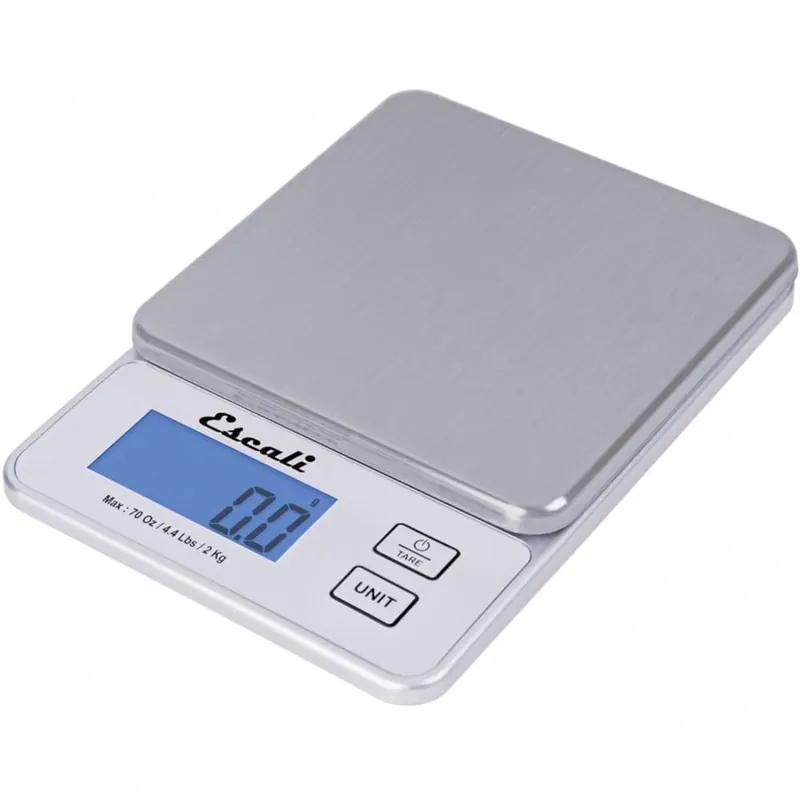
Escali Vera PR2000S Compact Scale
A compact high-precision scale with a backlit display and a removable stainless plate that goes in the dishwasher.
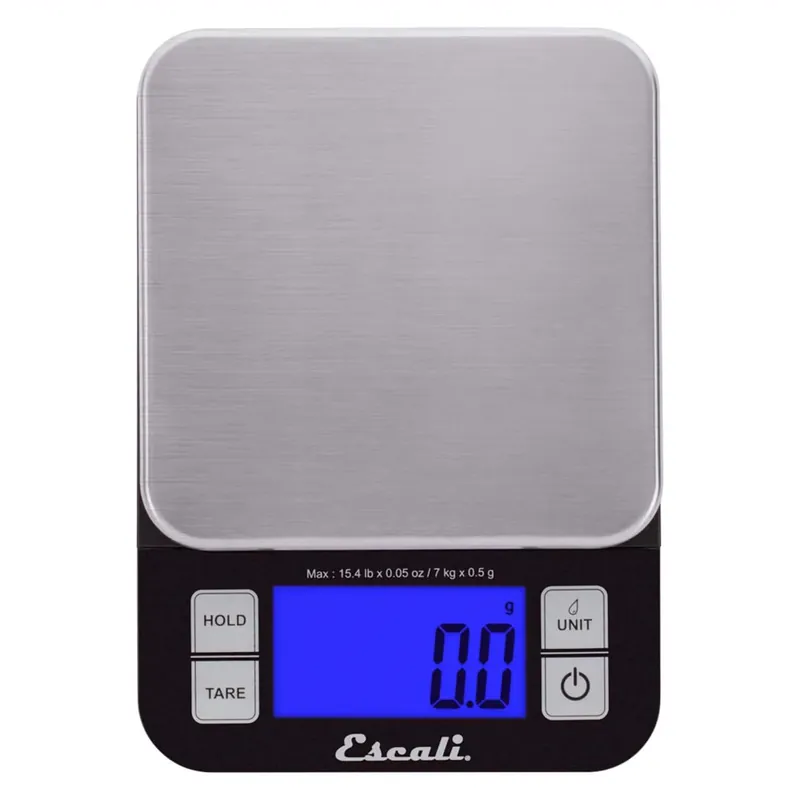
Where does a scale fit in the rest of your baking routine?
Weighing gets the ingredients right going in. Knowing when something is done is a temperature question, and the measure-instead-of-guess habit carries straight over to our guide to using a meat thermometer, which covers where to place a probe and how to calibrate one. The same instant-read thermometer that checks a roast can tell you how warm your milk or butter is before it goes into a dough.
Cold storage plays its part as well. Dough that rests overnight, butter you keep cold for pie crust and a frosted cake waiting for the party all spend time in the fridge. Before you trust it with a long rest, it helps to check that your fridge and freezer actually hold safe temperatures, since a door opened all afternoon on a baking day can change what is happening on the shelves.
If you are new to baking by weight, convert one recipe you already make often. Write the grams beside every line, bake it twice, and compare. The second bake tells you whether the weights suit your oven and your pan, and from then on the recipe card does the remembering for you. When you are ready to choose a scale, every model mentioned here sits in our kitchen scale range, with capacity, units and controls listed on each card.