
Baking Tips · 11 min read · Updated November 15, 2026
10 Professional Baking Secrets: Why Weight Accuracy Matters More Than Volume
Professional bread formulas are written in grams, percentages and hydration rather than cups, because a number on a scale means the same thing in every kitchen, and those working habits carry straight over to a home counter.
Professional bread formulas are written in weight. Ingredients go onto a scale, and a batch can be doubled or halved with one line of arithmetic. The NIST Office of Weights and Measures describes measuring ingredients by mass with a kitchen scale as a best practice for recipe accuracy, ahead of fluid or dry measuring cups.
If you already weigh flour for cakes, our guide to baking by weight with a cups-to-grams chart covers the basics of converting a recipe and using tare in one bowl. The habits professionals rely on pick up where that leaves off: planning a dough, adjusting it, and getting the same loaf out of the oven week after week.
1. Write every formula with flour as 100%
Baker's percentage is the shared language of professional bread baking. In King Arthur Baking's explanation of baker's percentage, each ingredient is expressed as a percentage of the flour weight, and flour is always 100%. The math fits on a sticky note: divide the ingredient weight by the flour weight and multiply by 100.
Their white bread example uses 50 lb of flour, 33 lb of water, 1 lb of salt and 0.6 lb of yeast. Written as percentages, that becomes 100% flour, 66% water, 2% salt and 1.2% yeast. The pounds stop mattering. Any baker who reads "2% salt" knows how salty the bread will be, whatever size the batch.
| Ingredient | White bread, by weight | White bread, baker's % | Ciabatta, baker's % |
|---|---|---|---|
| Flour | 50 lb | 100 | 100 |
| Water | 33 lb | 66 | 73 |
| Salt | 1 lb | 2 | 1.8 |
| Yeast | 0.6 lb | 1.2 | 1.1 |
King Arthur gives three reasons the system works. Every ingredient is weighed, so there is one unit of measure. A formula scales up or down without rewriting it. And bakers in different kitchens can compare doughs without translating anyone's cups. The method also runs in reverse: weight equals the percentage divided by 100, times the flour weight. For a ciabatta made with 500 g of flour, that gives 365 g of water, 9 g of salt and 5.5 g of yeast.
2. Read hydration as a number, not a feel
Hydration is the percentage of liquid in a dough, based on the flour weight. By that measure the white bread above sits at 66% hydration, while the ciabatta runs at 73%. Those seven points explain why one dough holds its shape on the bench and the other spreads into a slack, sticky sheet.
Once hydration is a number, you can change it on purpose. Your flour may drink more water than the flour a recipe was written for. With 500 g of flour, each percentage point of hydration is 5 g of water. Add 10 g and you have moved the dough two points, a change you can write down and repeat. Guess with a splash from the tap and the next bake starts from zero again.
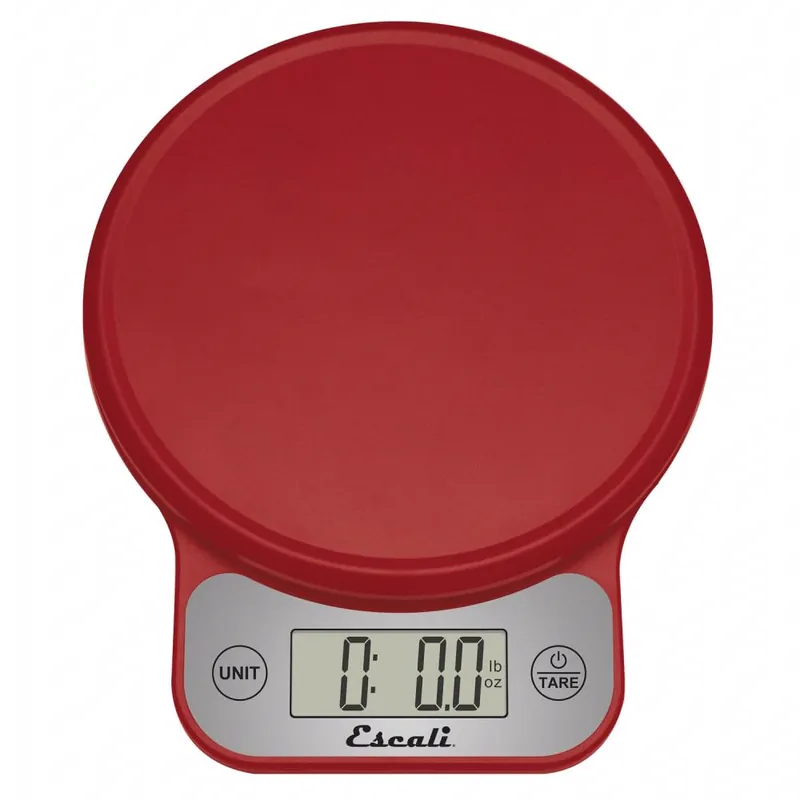
Pour the water straight into the mixing bowl on the scale rather than measuring it first. Our Telero food scale is made for both liquid and dry ingredients and reads in steps of 1 gram, 0.01 ounce or 0.001 pound, so the water lands in the same bowl as the flour. Its large platform keeps the display visible under a wide bowl.
3. Rescale a formula with one conversion factor
Professionals do not double and halve recipes ingredient by ingredient. They use a conversion factor, and King Arthur lays out the steps. Add up the percentages of the formula. Their French bread comes to 100 + 65 + 2 + 1.25 = 168.25. Divide the dough weight you want by that sum. In their worked example, 150 ÷ 168.25 = 0.8915, which they round up to 0.9. Then multiply every percentage by the factor.
You can run the same steps at home. Say you want about 1,000 g of French bread dough. Divide 1,000 by 168.25 and you get 5.94, which rounds up to 6. Multiply each percentage by 6, and the weights fall out with no guesswork about tablespoons.
| Ingredient | Baker's % | Weight with factor 6 |
|---|---|---|
| Flour | 100 | 600 g |
| Water | 65 | 390 g |
| Salt | 2 | 12 g |
| Yeast | 1.25 | 7.5 g |
| Total | 168.25 | 1,009.5 g |
The same factor works for any size. A 2,000 g batch uses a factor of 12, and nothing else in the formula changes.
Check that your scale can carry the batch plus the bowl. The Primo digital scale has a capacity of 11 lb (5,000 g) and reads in 0.05 oz (1 g) increments, enough for a kilogram of dough in a heavy mixing bowl with room to spare.
4. Count the flour hiding in your preferment
Some bread formulas start with a preferment, such as a poolish made from equal weights of flour and water. King Arthur notes that a preferment can make a formula look odd. Salt might appear as 3% and water as 48%, because those figures are measured against the flour added at the final mix only.
The fix is the Overall Baker's Percent, which adds the preferment's flour and water back into the totals. Their French bread with poolish works out to 65% water, 2% salt and 1.25% yeast overall, the same dough as before seen from a different angle.
Here is how that plays out with the 600 g batch from the previous step. Put a third of the flour into a poolish: 200 g of flour and 200 g of water. The final mix then gets 400 g of flour, 190 g of water and the 12 g of salt. Against those 400 g alone, salt reads as 3% and water as about 48%. Add the poolish back and you are at 65% water and 2% salt again.
You can only do this bookkeeping if both parts were weighed. Write the poolish and the final mix as separate lines, with the overall percentages in the margin, so a salty or slack loaf points you to the number to move.
5. Weigh salt and yeast instead of spooning them
Small amounts carry big effects in bread, and spoons treat them unevenly. King Arthur Baking's ingredient weight chart lists a tablespoon of table salt at 18 g, a tablespoon of Morton's kosher salt at 16 g and a tablespoon of Diamond Crystal kosher salt at 8 g. The chart also puts 2 1/4 teaspoons of instant yeast at 7 g.
Think back to the 12 g of salt in the rescaled French bread. In table salt that is two thirds of a tablespoon. In Diamond Crystal it is a tablespoon and a half. A formula written in grams gives you the right amount from either box, and the brand stops being a hidden variable.
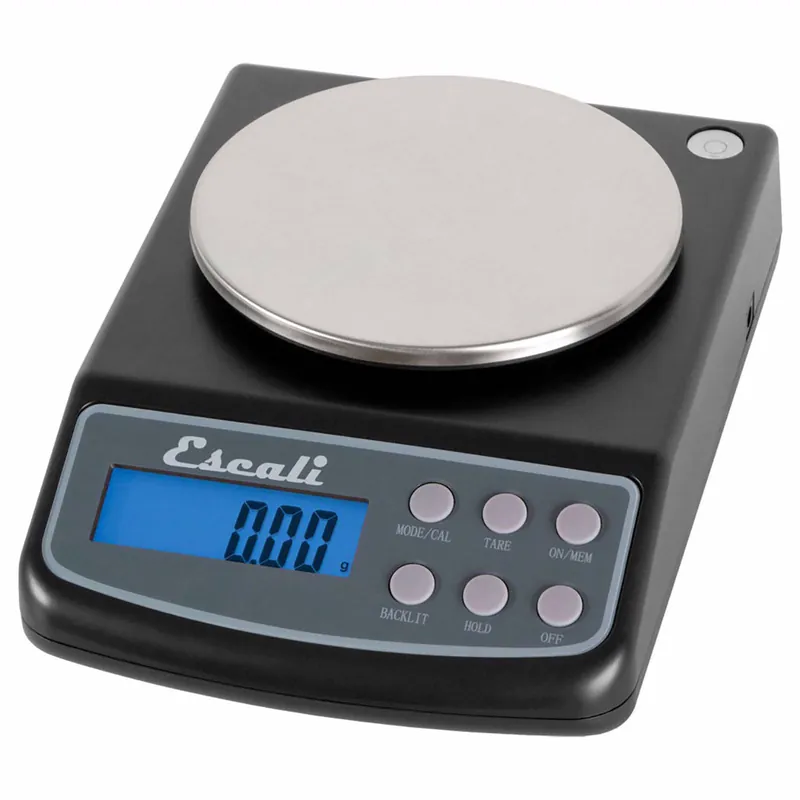
A kitchen scale that reads in whole grams shows 7.5 g of yeast as 7 or 8, and the Telero, for example, starts registering at 5 grams. For fractions of a gram, a lab-style scale does the small work beside the main bowl. Our L125 precision lab scale holds up to 125 g and reads in 0.01 g steps, with a removable stainless steel top. Weigh yeast, salt or spices on it, then tip them into the main bowl. The same habit pays off with even tinier quantities, the kind that come up in precise home cooking with tiny amounts of gelling agents.
6. Crack eggs onto the scale and pour to the gram
Eggs look like a fixed unit, yet a recipe that says "two eggs" leaves the actual amount to chance. King Arthur's chart lists a large fresh egg at 50 g, a large white at 30 to 35 g and a large yolk at 14 g. Your own eggs will not all hit those numbers, and a formula written in grams does not care.
Set a small cup on the scale, press tare, and crack the eggs in. Whisk lightly, then pour into the batter until the display reaches your target. A recipe that expects three large yolks is asking for roughly 42 g, and weighing gets you there even when your eggs run small.
7. Pour sticky ingredients into the bowl on your Escali scale, then lift it off to mix
NIST's guide to cookware and tools for metric cooking singles out sticky ingredients such as honey and molasses. Weighing is faster than measuring them by volume, and you press tare to zero after each ingredient instead of washing several cups and spoons. King Arthur's chart puts honey at 21 g per tablespoon and molasses at 85 g per quarter cup, so a recipe in spoons converts easily before you start.
Set the bowl on the scale, tare, and pour the syrup in until the display reaches the number. Nothing clings to a spoon, so all of it ends up in the dough.
The same NIST page gives a rule that protects the scale itself. Do not mix while the bowl sits on the platform. Lift the bowl to a stable surface first, then stir, whisk or knead. Mixing on the platform risks damaging the scale, and no batch is worth that.
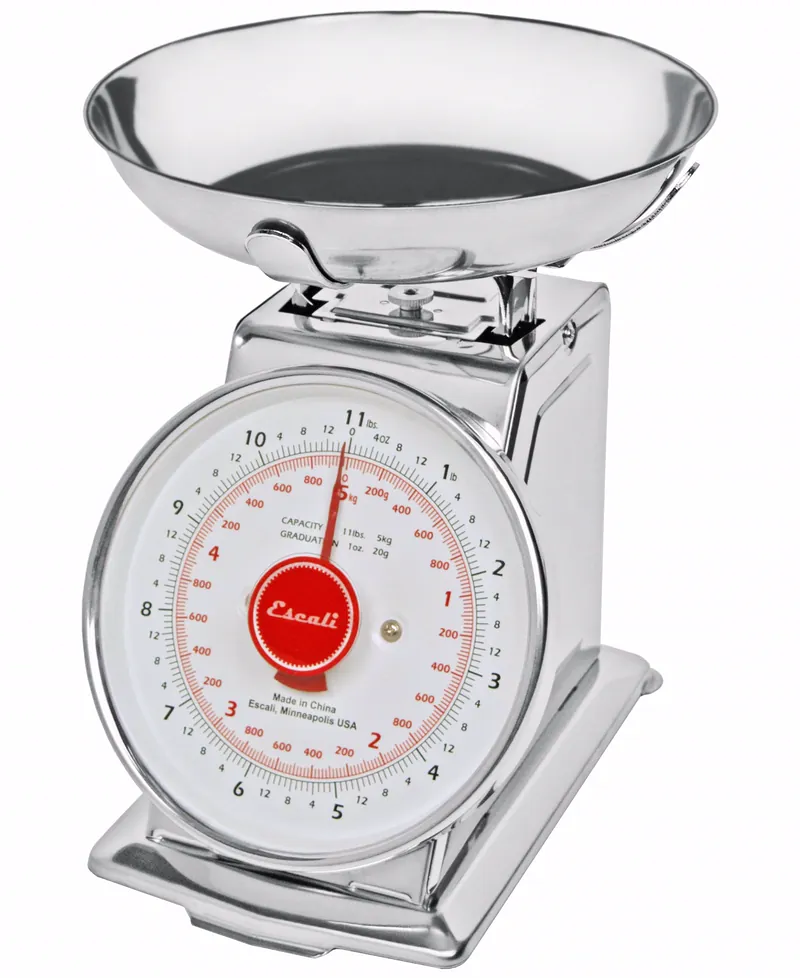
A removable bowl makes that rule easy to follow. The Retro Classic mechanical scale comes with a stainless steel bowl that lifts off and goes in the dishwasher. It has a tare feature, reads in both lb:oz and kg:g on its dial, and needs no batteries. For a digital scale, NIST suggests thinking about the gross weight of your typical recipes, ingredients plus bowl, and names 5 kg as a common choice for home cooking. Our notes on how to choose a kitchen scale go further into capacity and platform size.
Escali Telero Food Scale
A broad platform keeps the display readable under a large mixing bowl, and the sealed panel keeps flour and liquid out.
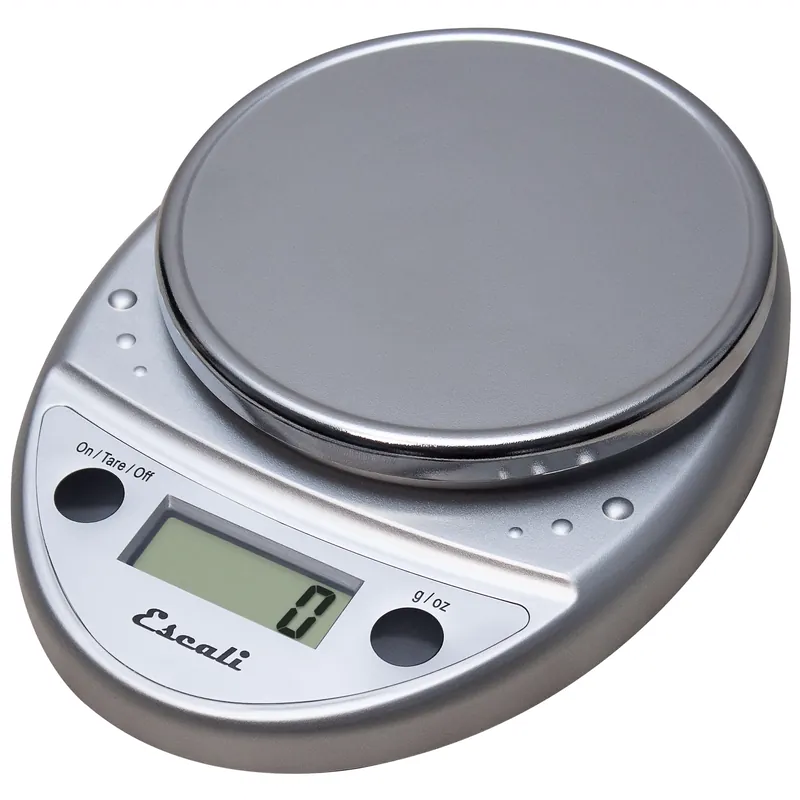
Escali Primo Digital Food Scale
A sealed two-button scale with a rounded body that wipes clean, weighing up to 11 lb in 1 g steps.
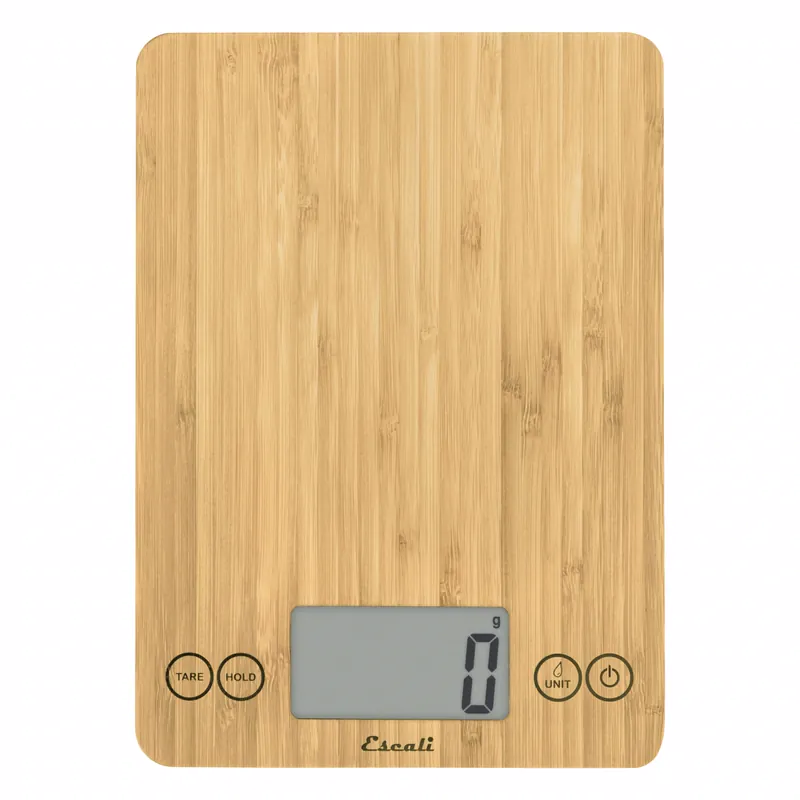
Escali Arti Glass Food Scale
A tempered glass top with a large touch screen that keeps the reading on display after you lift the bowl.
8. Convert an old family recipe by measuring first, then weighing
Handwritten recipe cards rarely come with grams. Instead of a generic conversion chart, NIST points to a safer route. Measure each ingredient with a traditional tool, the way the card says, and then weigh the result in grams on a kitchen scale.
Two details make that measurement fair. First, use the right cup. NIST lists using a dry measuring cup instead of a fluid one, or the reverse, as a common way of introducing errors. Second, use it properly. Read a fluid cup on a level surface with your eye at the line, and strike off the excess from a dry cup with a straight edge.
Units can trip you up as well. NIST notes that customary measures such as teaspoons, cups and pints mean different things in different countries, and that the United States has two units named ounce. A fluid ounce measures volume, while an avoirdupois ounce measures weight. So a card that says "8 ounces of honey" could mean either one.
Write the gram figure next to each line once you have it. From then on the card is a formula, and anyone who bakes from it gets the same cake rather than a guess at someone else's cups. A scale with display hold helps when a wide bowl hides the screen. The Pico compact scale keeps the reading on screen after you lift an item off, and the Arti offers the same hold along with fluid ounces and milliliters as units.
9. Measure your pans with water and an Escali scale
Batter fills a pan by volume, so it pays to know how much each pan holds. NIST describes a simple method. Set the empty pan on the scale, tare it, and fill it to the rim with tap water. Read the grams. Because water weighs about 1 g per mL, the display gives you the volume, so 1,000 g of water means about 1 L.
NIST also publishes approximate volumes for standard pans by their inside dimensions.
| Pan | Inside dimensions | Approximate volume |
|---|---|---|
| Rectangle | 18 x 28 cm | 3 L |
| Rectangle | 23 x 33 cm | 3.5 L |
| Square | 20 x 20 cm | 2 L |
| Square | 23 x 23 cm | 2.5 L |
| Round | 20 cm | 1.2 L |
| Round | 23 cm | 1.5 L |
| Springform | 23 cm | 2.5 L |
| Springform | 27 cm | 3 L |
| Loaf pan | 20 x 10 cm | 1.5 L |
| Deep loaf pan | 23 x 13 cm | 2 L |
| Pie plate | 23 cm | 1.25 L |
Volumes turn pan swaps into arithmetic. Moving a cake from a 20 cm round to a 23 cm round means going from 1.2 L to 1.5 L, a quarter more space. Use the conversion factor habit from step 3: multiply the batter by 1.25 and the cake bakes at about the same depth. A 23 x 23 cm square and a 23 cm springform both hold about 2.5 L, so one can stand in for the other.
Your own pans may not match the table, so weigh each one with water once and write the volume on tape underneath. A large rectangle full of water is heavy, and you need a capacity that covers the water plus the pan. The Arti glass scale weighs up to 15 pounds, a comfortable margin for most home bakeware.
10. Check the oven and the thermometer, not only the ingredients
Weighing gets the dough right, but heat finishes the job. NIST notes that each oven, although similarly made, has its own temperature variations. A formula weighed to the gram can still bake too dark if the dial on your oven reads lower than the air inside it.
USDA's guidance on appliance thermometers describes the check. Hang an oven thermometer from a rack in the center, preheat to 325 to 350 °F, read it, and check again after 5 minutes. Repeat at several settings, such as 325, 350, 375 and 400 °F. If the oven is consistently high or low by the same amount, say 25 °F, factor it in. An oven that runs hot by 25 °F, with a recipe that says 350 °F, gets set to 325 °F. If it does not hold temperature at all, USDA says the thermostat needs an authorized service center.
Test your food thermometer too. USDA's page on food thermometers says to put the stem at least 2 inches into boiling water, away from the pot, and wait at least 30 seconds. At sea level it should read 212 °F, which NIST gives as 100 °C. At high altitude water boils lower, likely at least 2 °F and as much as 5 °F lower, and NIST adds that baking at altitude needs adjustments of its own. Our guide to using a meat thermometer walks through calibration in more detail.
The DH1 gourmet digital thermometer is designed to measure the internal temperature of foods like meat or baked goods, with an extra-long probe and a pocket sheath. The rest of our probes and dial models sit in the thermometer collection.
Escali L125 Precision Lab Scale
A 125 g lab scale that reads in 0.01 g steps under a removable stainless top.
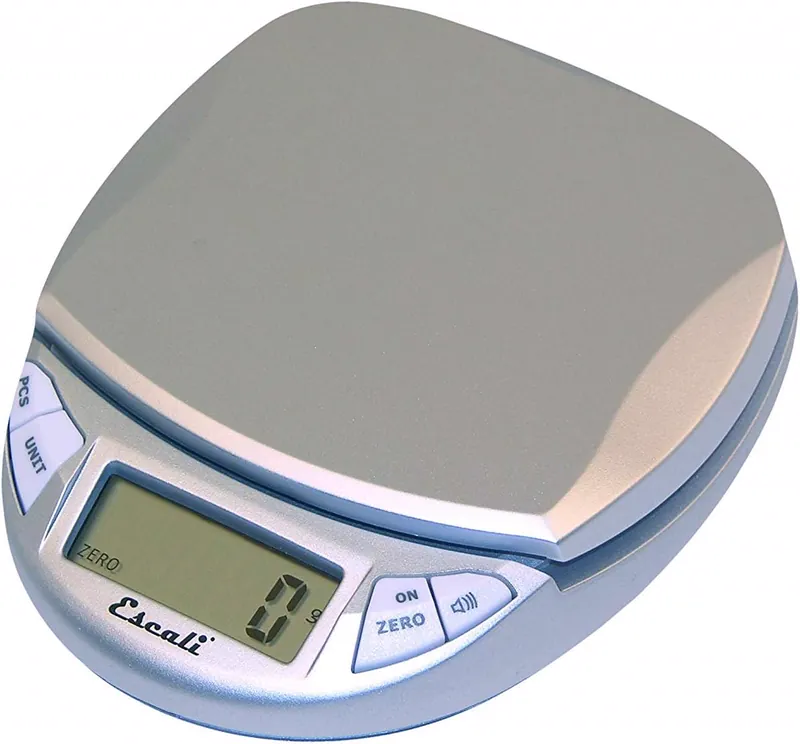
Escali Pico Compact Scale
A pocketable 11 lb scale that holds the reading after you lift the load and counts small parts.
Escali Retro Classic
Classic design with modern precision. Analog display and highest quality stainless steel.
Where should you start?
Pick one bread you already bake and rewrite it in grams, then in baker's percentages. Note the hydration, weigh the salt, and bake it twice before you change anything. After that, every adjustment is a number you can record and repeat. Our full kitchen scale range lists capacity, units and controls on each card, and the lab and platform scales cover the very small and the very large.