
Kitchen Know-How · 11 min read · Updated November 15, 2026
Fridge and Freezer Temperatures: 40 °F, 0 °F and How to Check
Your refrigerator should hold 40 °F or below and your freezer 0 °F, according to USDA. Here is how to read the real temperature inside each one, fix a warm shelf, and keep track of how long food lasts.
It is easy to go years without measuring the temperature inside a refrigerator. The food goes in, the door closes, and the cold air is taken on trust. Two numbers decide whether that trust is earned: 40 °F for the fridge and 0 °F for the freezer. Both come from the U.S. Department of Agriculture, and both are easy to check once you have a thermometer that lives inside the appliance.
Why do 40 °F and 0 °F matter?
USDA's appliance guidance puts it plainly. Pathogens grow very slowly below 40 °F, multiply rapidly between 40 and 140 °F, and are destroyed above 140 °F. That middle band is what food safety people call the Danger Zone. In its refrigeration guidance, USDA adds that in this range some bacteria can double in as little as 20 minutes, and that a refrigerator set at 40 °F or below will protect most foods.
So the fridge target is a ceiling, not a goal to aim at exactly. Refrigerators should maintain no higher than 40 °F. The freezer number works a little differently. USDA says frozen food holds top quality longest when the freezer maintains 0 °F, which makes 0 °F a quality line as much as a safety line.
There is a second reason the number matters more than your nose. According to USDA, the bacteria that make people sick usually do not change the taste, smell or look of food. The spoilage bacteria that do cause off smells are a different group. A container of soup can smell fine and still have spent too long above 40 °F. One more detail is worth knowing: Listeria monocytogenes thrives at cold temperatures, which is one reason USDA asks you to clear out old perishables once a week rather than trusting the cold alone.
USDA also sets a time limit on warm food. Foods held above 40 °F for more than 2 hours should not be consumed. That rule is the one you will lean on after a long grocery run, a party buffet, or a power cut.
Why the dial inside your fridge is not a reading
The control knob or touchpad inside a refrigerator sets how hard the unit cools. It does not tell you what the air on the middle shelf is actually doing today, with a full load of groceries and a door that was opened twenty times since breakfast. A setting labeled "colder" on one appliance can land at a very different temperature on another.
That is why USDA recommends keeping an appliance thermometer in the fridge and in the freezer at all times. A thermometer turns the guesswork into a figure you can act on. It also gives you a record of sorts: glance at it each time you reach for the milk and you will notice if the number starts to creep.
Escali makes three thermometers built for this job, and you can see all of them in the Escali thermometer collection. Each one is designed to sit, hang or stick inside a cold compartment and stay there.
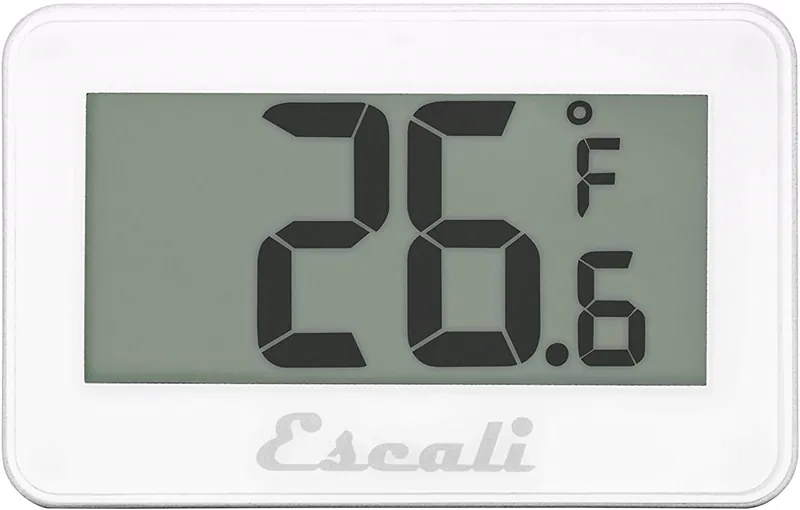
Escali DHF1 Digital Fridge Thermometer
Large digits for the fridge, freezer or pantry; it stands, hangs or holds on with a magnet.
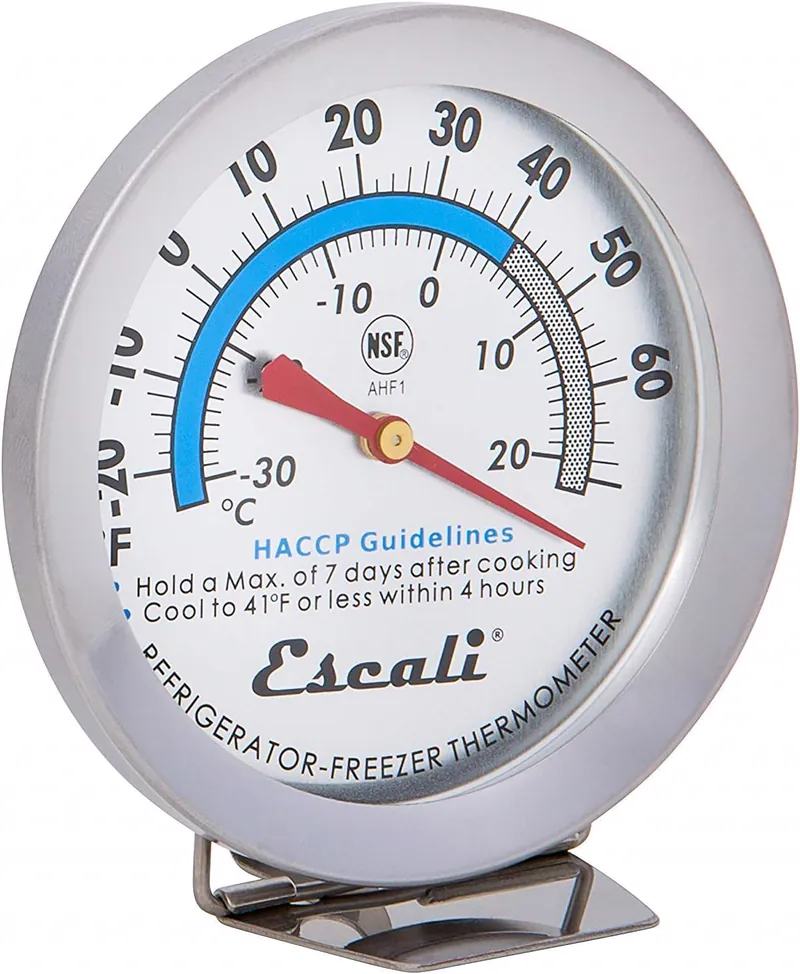
Escali AHF1 Dial Fridge Thermometer
A 2.9-inch dial with the cold-storage zone in blue; it stands on a shelf or hangs from a rack.
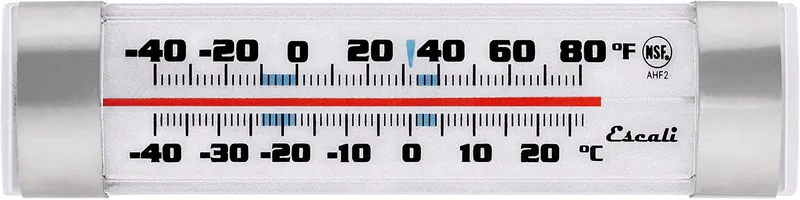
Escali AHF2 Glass Fridge Thermometer
A shatterproof glass tube with fridge and freezer zones marked, mounted with suction cups.
How to measure your refrigerator, step by step
USDA's method for the fridge is simple, and it rewards patience more than skill.
- Fill a glass with water and set your appliance thermometer in it.
- Place the glass in the middle of the refrigerator, not against the back wall and not in the door.
- Wait 5 to 8 hours before you read it.
- If the reading is between 38 and 40 °F, the fridge is where it should be.
- If it is not, adjust the temperature control, then check again after another 5 to 8 hours.
The glass of water is the clever part. Air temperature swings every time the door opens, so a thermometer hanging in open air can show you a gust of warm kitchen air rather than the steady temperature your food is sitting in. Water changes slowly, the way a carton of milk or a tub of leftovers does, so the reading reflects what the food itself is experiencing.
The waiting time matters just as much. A reading taken ten minutes after you set the glass down mostly tells you how warm the tap water was. Set it up before bed and read it in the morning.
The Escali AHF1 dial thermometer reads from -20 to 70 °F on a 2.875-inch stainless steel dial, with a blue cold-storage zone that marks air at or below 41 °F. That blue zone follows the HACCP cold-holding reference printed on the dial face. USDA's home target is 40 °F or below, so you want the needle sitting comfortably inside the blue rather than resting on its top edge.
How to measure your freezer
The freezer check follows the same rhythm with one change in placement. USDA says to put the thermometer between frozen food packages, wait 5 to 8 hours, and look for a reading of 0 to 2 °F. If the freezer is outside that range, adjust the control and check again after 5 to 8 hours.
Placing the thermometer between packages gives it the same job the glass of water does in the fridge. Frozen food holds its temperature, so the thermometer reads the cold your food is actually kept at rather than the blast from the vent.
You need a thermometer whose scale goes well below zero for this. The Escali AHF2 glass thermometer reads from -40 to 80 °F, with the ideal refrigerator and freezer zones and the freezing point marked on its face. It comes with suction cups for mounting on an interior wall, or you can hang it from a rack. The Escali DHF1 digital thermometer reads down to -4 °F on a large LCD that shows both Fahrenheit and Celsius, and it can stand on a shelf, hang from a rack or attach to an interior wall with its magnetic mount.
| Appliance | USDA target | Where the thermometer goes | Wait before reading | Reading that calls for an adjustment |
|---|---|---|---|---|
| Refrigerator | No higher than 40 °F | In a glass of water, middle of the fridge | 5 to 8 hours | Outside 38 to 40 °F |
| Freezer | 0 °F for top quality | Between frozen food packages | 5 to 8 hours | Outside 0 to 2 °F |
| After adjusting either one | Same targets | Same place as before | Another 5 to 8 hours | Repeat until it holds |
| After a power outage | Fridge 40 °F, freezer 0 °F or below | Thermometer kept inside at all times | Read when power returns | Above those numbers |
| Oven | Set to 325 °F or higher for meat and poultry | Oven thermometer hung from a rack in the center | Read at preheat, again after 5 minutes | Off by the same amount at several settings |
Adjusting and re-checking without chasing the number
When the first reading comes back high, the temptation is to turn the control all the way to its coldest setting. A smaller step works better. Move the control a notch, then leave it alone for the 5 to 8 hours USDA recommends before you judge the result. A refrigerator takes time to settle, and adjusting it again after an hour only tells you about the last change you made, not the one before it.
Keep the thermometer in the same spot each time you check. If you move the glass from the middle shelf to the top shelf between readings, you are comparing two different places rather than measuring one change. Once the fridge holds between 38 and 40 °F and the freezer between 0 and 2 °F, you are done. Leave the thermometer where it is and glance at it now and then.
Where do warm spots hide in a refrigerator?
USDA wants the temperature to be 40 °F or below throughout the unit, not just on the shelf where the thermometer happens to live. A few habits and places make that harder.
The door
The door bins are the warmest and least steady part of most refrigerators. USDA advises against storing perishable foods in the door, because temperatures there fluctuate more than in the cabinet. Eggs belong in their carton on a shelf, not in the molded egg tray many doors come with. The door is a fine home for condiments and drinks that handle a little temperature swing.
Opening the door
Every time the door opens, warm room air comes in. USDA's advice is to keep doors closed tightly and not to open them more than necessary. Decide what you want before you open the fridge, close it while you stand at the counter, and check that the gasket seals evenly all the way around.
Crowding
Cold air has to move to reach the food. A fridge packed wall to wall can leave pockets that never cool as well as the rest of the cabinet. If your thermometer reads fine in the middle but you suspect a packed corner, move the glass of water there for one round of checks and compare.
The condenser coil
The coil that sheds heat from the refrigerator collects dust over time. USDA recommends cleaning the condenser coil several times a year with a brush or vacuum and keeping the front grill free of dust. It is a quick job, and it helps the appliance hold its temperature.
Raw meat and juices
Temperature is only part of good fridge storage. USDA asks that raw meat, poultry and seafood be sealed or wrapped so their juices stay off other foods. A rimmed container on the lowest shelf does this well.
How should you cool hot food?
Many cooks were taught to let a pot of soup sit on the stove until it cools before refrigerating it. USDA's refrigeration guidance says otherwise: hot food can go directly into the refrigerator, or you can chill it quickly in an ice or cold water bath first.
The bigger issue is size. A deep stockpot holds its heat for a long time, and the center can linger in the Danger Zone well after the edges feel cool. USDA recommends dividing a large pot of soup or stew into small portions in shallow containers, and dividing large cuts of meat or whole poultry into smaller pieces before chilling. Shallow containers let the cold reach the middle quickly.
A kitchen scale makes the dividing easy and even. Set an empty container on an Escali Primo digital scale, press tare to zero it out, and ladle in the same weight each time. The Primo weighs up to 11 lb (5,000 g) in 1 g steps, so it handles a full container of stew without trouble. Portions of equal weight cool at a similar pace and reheat evenly later. If you already weigh flour and sugar the way we describe in our guide to measuring ingredients by weight for baking, the same scale and the same tare habit carry straight over to leftovers.
Reheating leftovers with an Escali probe thermometer
Cold storage is half of the leftover story. The other half is how hot they get on the way back to the table. USDA's safe temperature chart lists leftovers and casseroles at 165 °F, measured with a food thermometer.
A fridge thermometer cannot do this job, so a probe thermometer joins the routine here. The Escali DHP3 waterproof thermometer reads from -58 to 572 °F in about 4 seconds through a step-down probe tip, and it is IPX7 waterproof, so you can rinse it under the tap between a pan of rice and a bowl of chili. For a deep casserole dish, the Escali DH1 Gourmet Digital Thermometer has an extra-long probe that reaches the center. Push the probe into the middle of the food, where it heats last, and stir and check again if one spot reads lower than another. Our guide to using a meat thermometer covers probe placement in more detail, and the same rules apply to a dish of leftovers.
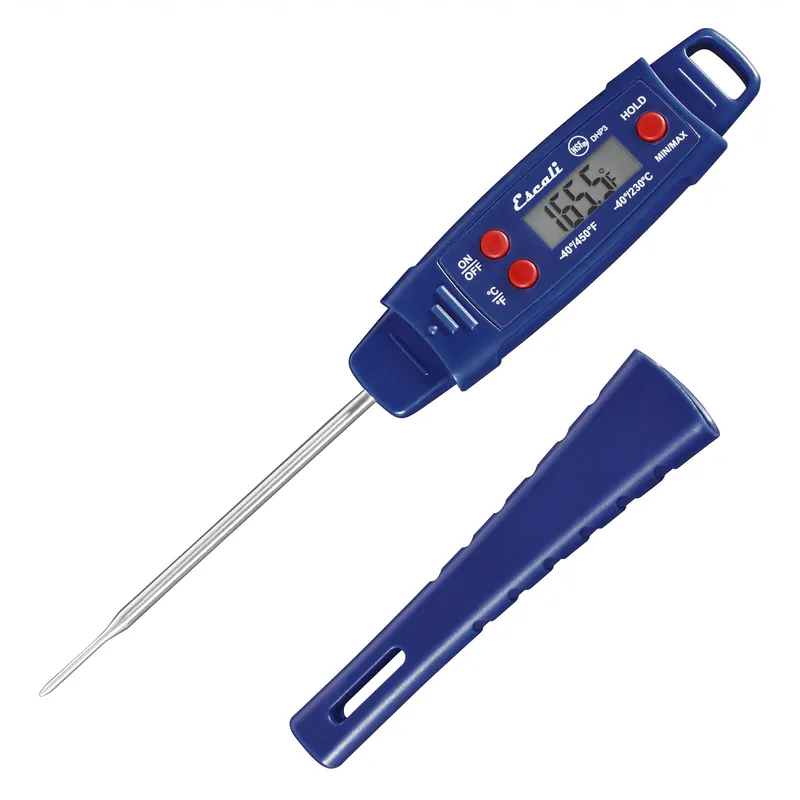
Escali DHP3 Waterproof Meat Thermometer
Reads in about four seconds through a 1.8 mm tip and rinses under the tap, rated IPX7.
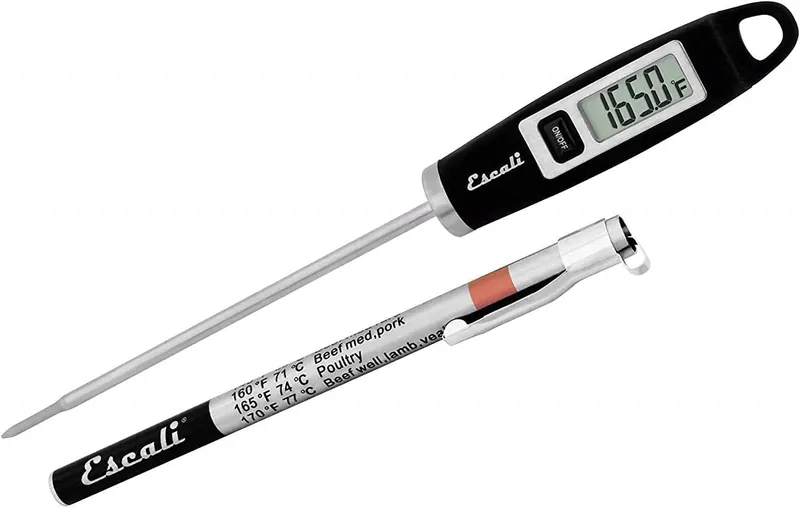
Escali DH1 Gourmet Digital Thermometer
A long step-down probe for roasts and bread, with a sheath that clips to a pocket and lists target temperatures.
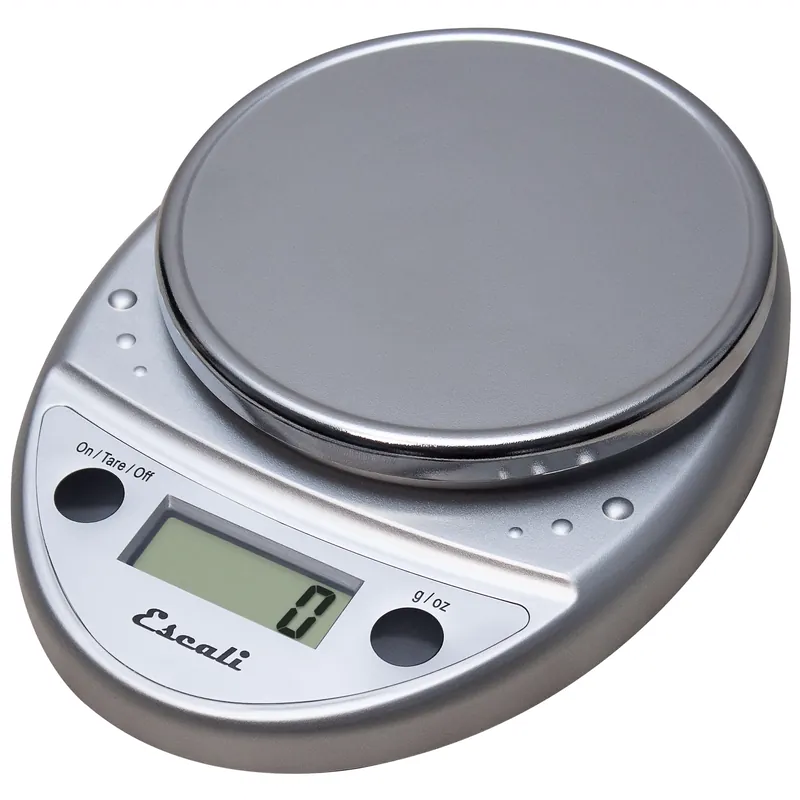
Escali Primo Digital Food Scale
A sealed two-button scale with a rounded body that wipes clean, weighing up to 11 lb in 1 g steps.
What happens to your fridge and freezer in a power outage?
This is where an appliance thermometer earns its place. USDA calls it critical during a power outage: when the power comes back, if the refrigerator is still at 40 °F and the freezer at 0 °F or below, the food is safe.
Without a thermometer inside, you are left guessing from how long the outage felt and how cold the milk seems to the touch. With one inside, you open the door once, read the number, and decide. Keep the doors shut during the outage itself, in line with USDA's advice not to open them more than necessary, so the cold you already have lasts as long as possible.
If the fridge reading has climbed above 40 °F, the 2-hour rule applies to the perishables inside. USDA says foods held above 40 °F for more than 2 hours should not be consumed. A thermometer you read regularly also helps here, because you know roughly where the fridge stood before the outage began.
Which Escali fridge thermometer fits your kitchen?
All three do the same job, and the choice comes down to how you like to read a number and where you want to put it. If you prefer a digital figure in large print, the DHF1 suits you. A dial you can judge at a glance points to the stainless AHF1. For a slim thermometer that sticks to a freezer wall, the AHF2 with its suction cups is the natural pick. With one in each compartment, you never have to move a thermometer between checks.
| Model | Range | Display | Mounting | Marked zones | Price |
|---|---|---|---|---|---|
| Escali DHF1 digital | Down to -4 °F | Large LCD, °F and °C | Stand, hang or magnetic mount | None | $12.95 |
| Escali AHF1 dial | -20 to 70 °F | 2.875-inch dial, °F and °C | Stand on a shelf or hang with rear mount | Blue cold-storage zone, HACCP guidelines on dial | $16.95 |
| Escali AHF2 glass | -40 to 80 °F | Magnified shatterproof glass, °F and °C | Hang on a rack or suction cups | Fridge and freezer zones, freezing point | $16.95 |
A quick word on checking your oven
Ovens drift too, and USDA describes a parallel check for them. For meat and poultry, the agency says to set the oven at 325 °F or higher. To test it, hang an oven thermometer, which reads from 100 to 600 °F, from a rack in the center of the oven. Preheat to 325 to 350 °F, read the thermometer, and check again after 5 minutes.
If the oven is consistently high or low by the same amount, say 25 °F, at several settings such as 325, 350, 375 and 400 °F, USDA suggests factoring that into your cooking. An oven that runs 25 °F hot means a recipe calling for 350 °F should be set at 325 °F. If it will not hold a steady temperature at all, the thermostat needs an authorized service center. The Escali thermometers above are made for cold storage, and our probe thermometers measure food, so neither replaces a dedicated oven thermometer for this test. How the sensors across our thermometer line differ is set out in our overview of Escali technology.
How long does food keep in the refrigerator?
A cold fridge slows bacteria down. It does not stop the clock. USDA's rule of thumb for cooked leftovers is 4 days, and raw poultry and ground meats keep 1 to 2 days. The agency also suggests that once a week you throw out perishable foods that should no longer be eaten. Pick a day, perhaps the night before your grocery run, and make the sweep a habit.
The times below come from USDA's refrigeration chart and assume a refrigerator holding 40 °F or below, which is exactly what your thermometer confirms.
| Food | Time in the refrigerator |
|---|---|
| Ground meats | 1 to 2 days |
| Steaks, chops and roasts | 3 to 5 days |
| Chicken or turkey, whole or in parts | 1 to 2 days |
| Bacon | 7 days |
| Hot dogs, unopened package | 2 weeks |
| Hot dogs, opened package | 1 week |
| Luncheon meats, unopened package | 2 weeks |
| Luncheon meats, opened package | 3 to 5 days |
| Cooked leftovers, soups and stews | 3 to 4 days |
| Fresh fish and shellfish | 1 to 2 days |
| Eggs in the shell | 3 to 5 weeks |
| Hard-cooked eggs | 1 week |
Labeling containers with the date you made them takes the arithmetic out of these numbers. Combine that with a thermometer that reads 38 to 40 °F in the fridge and 0 to 2 °F in the freezer, and you are following USDA's guidance on cold storage with very little effort. USDA's full guidance covers more cases than these tables, and the thermometer gives you a clear, measured picture of the two appliances your food spends most of its life in.