
Equipment Reviews · 11 min read · Updated November 15, 2026
How to Choose the Perfect Kitchen Scale: Complete Buyer's Guide 2024
Capacity, increments, units, platform size and the way a scale cleans up decide whether it earns a spot on your counter. Work through them in order and the right model narrows itself down.
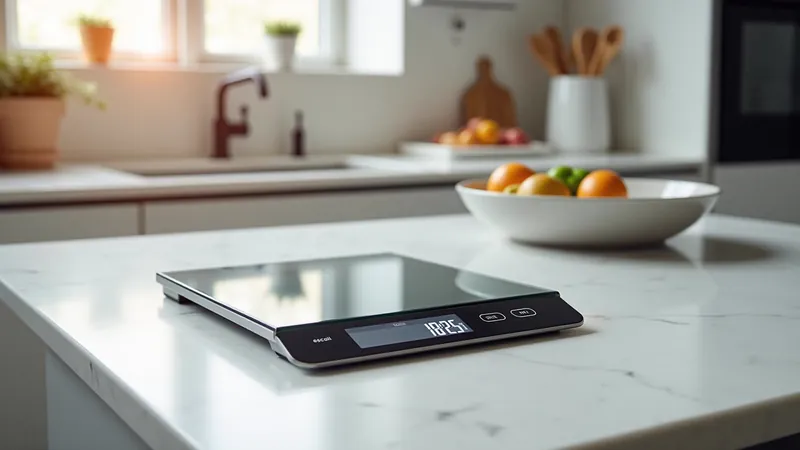
Most kitchen scales look alike in a photo: a flat platform, a small screen, two or three buttons. The differences show up on the counter. One scale vanishes under your mixing bowl, another switches itself off halfway through a recipe, and a third reads in steps too coarse for the pinch of yeast you need. Choosing well means asking a handful of plain questions before you look at color or price.
Start from what you will actually weigh. If you are new to weighing ingredients at all, our guide to baking by weight walks through the tare method and a cups-to-grams chart. Choosing the scale itself comes down to the numbers on the box.
How much capacity does your scale need?
Capacity is the most weight the scale can read, and the bowl counts against it. The NIST Office of Weights and Measures puts it simply in its notes on metric kitchen tools: consider the gross weight of your typical recipes, meaning the ingredients plus the bowl. A thin steel bowl adds very little, while a stoneware bowl or a cast iron pan can claim a large share of the limit before anything goes in.
NIST describes a 5 kg capacity as a common choice for home cooking and notes that commercial kitchens may need more. That lines up with the 11 lb (5,000 g) of our Primo digital scale and the 11 lb of the Pico, F115 and T115S. Above that sit the Pana V136 and Alimento at 13 lb, the Arti and Nutro at 15 lb, and the ArtiXL at 22 lb (10 kg).
To find your own number, weigh your heaviest bowl on any scale you already own, or check the bottom for a printed weight. Add the largest batch you make, such as a double loaf of dough or a big pot of soup. If the total sits close to a scale's limit, move up one size.
Bigger is not automatically better, though. NIST also points out that a smaller-capacity scale is handy for small quantities such as herbs and spices. A compact scale fits a drawer, travels well and often reads in finer steps. Keeping two is a sensible setup: a large one for the bowl and a small one beside it for the little amounts.
Which increment do you need: 1 g, 0.1 g or 0.01 g?
The increment, sometimes called readability, is the smallest change the display can show. A scale that reads in 1 g steps shows 120 g of flour as 120, and the next reading up is 121. For flour, sugar, butter, liquids and meat, whole grams are more than enough.
Small amounts are another matter. King Arthur Baking's ingredient weight chart lists 1 teaspoon of baking powder at 4 grams, half a teaspoon of baking soda at 3 grams and 2 1/4 teaspoons of instant yeast at 7 grams. On a 1 g scale, a 3 g reading can mean a little more or a little less than 3. At that size the hidden fraction becomes a real share of the dose.
A scale reading in 0.1 g or 0.5 g steps handles those amounts with room to spare. Our Supernova measures in steps of 0.5 g, 1 g, 0.05 oz and 0.1 oz, and the Telero can weigh in 1 gram, 0.01 ounce or 0.001 pound steps for finer work.
Hundredths of a gram belong to a narrower set of jobs. The HarvardX spherification handout calls for 0.5 g of sodium alginate per 100 g of liquid, and a half-size test batch needs 0.25 g. A scale that reads in whole grams cannot show that amount at all. Our L125 precision lab scale reads 125 g in 0.01 g steps, which is the kind of tool those recipes assume. If that style of cooking interests you, our piece on molecular gastronomy at home shows where the extra decimal place earns its keep.
Finer steps come with a smaller capacity, so the L125 cannot double as your bread scale. Match the increment to the smallest amount you weigh often, then cover everything else with a second, larger scale.
| Scale | Capacity | Smallest increment | Platform and surface | Power and auto-off |
|---|---|---|---|---|
| Primo | 11 lb (5,000 g) | 1 g (0.05 oz) | Sealed control panel, rounded body | Battery, off after 4 minutes |
| Retro Classic | 11 lb | Not stated | Mechanical dial, removable dishwasher-safe stainless bowl | No batteries |
| Vera PR2000S | 4.4 lb | Not stated | Removable dishwasher-safe stainless plate, sealed panel | Battery, off after 5 minutes |
| Arti | 15 lb | Not stated | Tempered glass, touch-sensitive screen | Two CR2032, off after 5 minutes |
| Alimento | 13 lb | Not stated | Elevated removable stainless platform | Battery or AC adapter, screen off after 30 seconds |
| Telero | Not stated | 1 g, 0.01 oz, 0.001 lb | Large platform, sealed panel | Battery, off after 5 minutes |
| ArtiXL | 22 lb (10 kg) | 1 g | Glass surface, touch controls | Not stated |
| Pico | 11 lb | Not stated | Compact body | Battery, off after 5 minutes |
| F115 | 11 lb (5 kg) | Not stated | Folding stainless platform | Battery, off after 5 minutes |
| T115S | 11 lb | Not stated | Glass surface, touch controls, reverse LCD | Battery, off after 5 minutes |
| Nutro | 15 lb (7,000 g) | Not stated | Stainless platform, touch controls | Battery, off after 5 minutes |
| Supernova | 13 lb (6 kg) | 0.5 g (0.05 oz) | Water resistant, NSF listed | Battery or optional 9 V adapter |
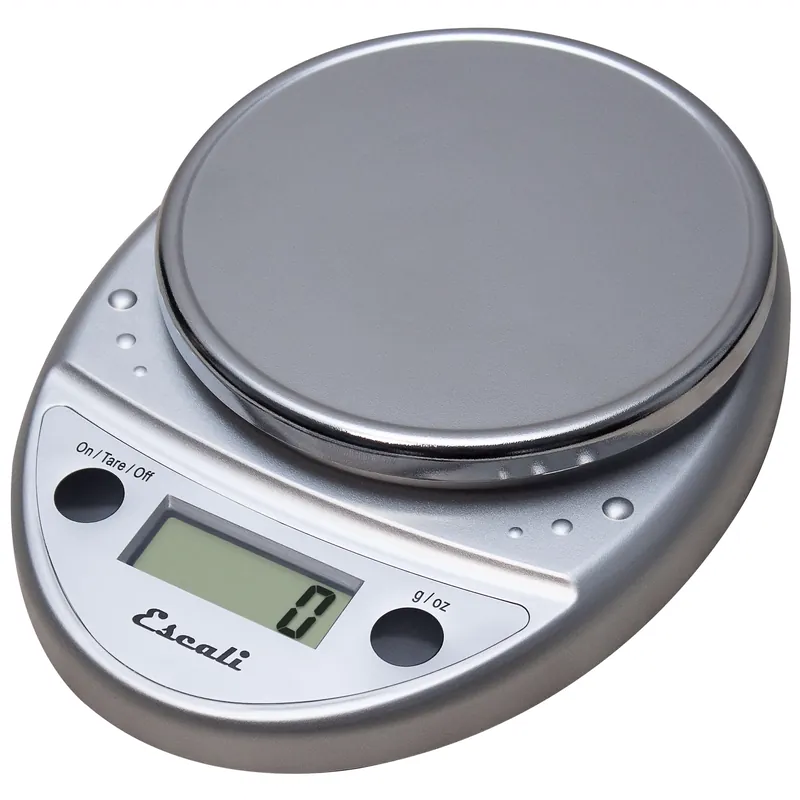
Escali Primo Digital Food Scale
A sealed two-button scale with a rounded body that wipes clean, weighing up to 11 lb in 1 g steps.
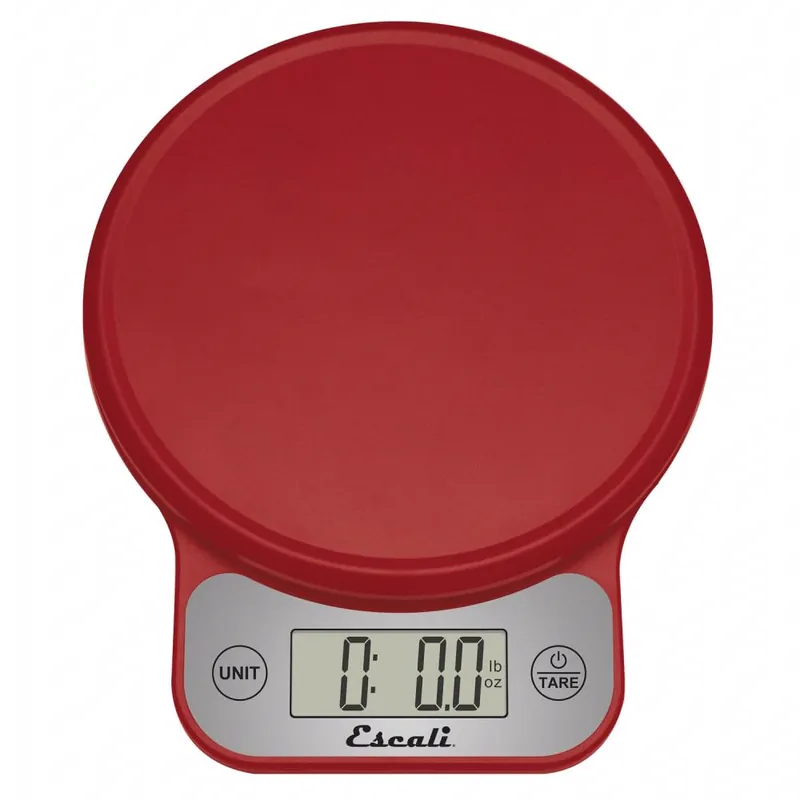
Escali Telero Food Scale
A broad platform keeps the display readable under a large mixing bowl, and the sealed panel keeps flour and liquid out.
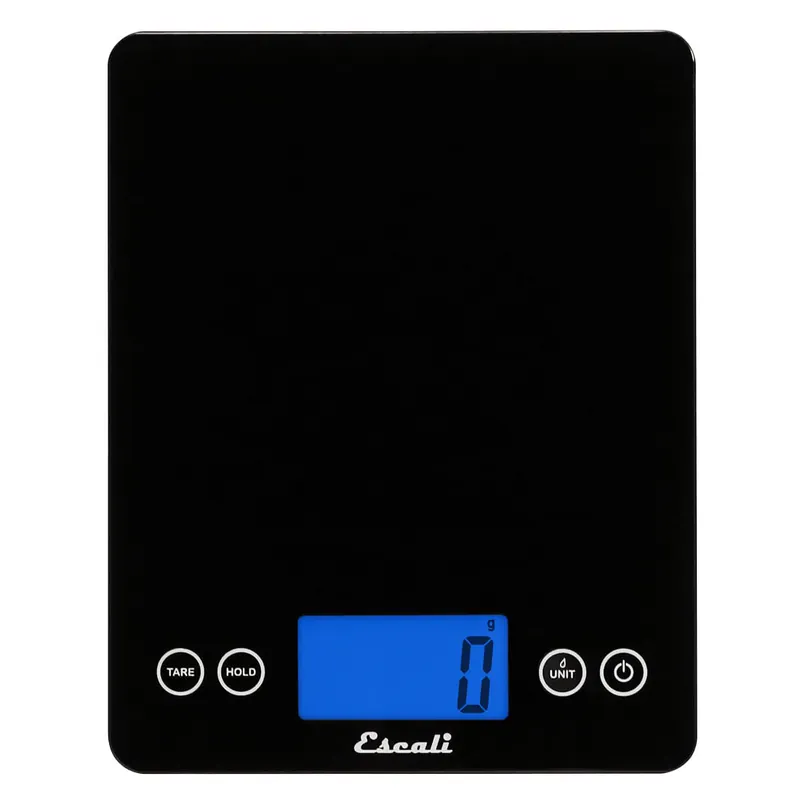
Escali ArtiXL Glass Scale
An extra-large glass platform that takes 22 lb in 1 g steps, with touch controls that wipe clean.
Ounces, fluid ounces and grams: which units should an Escali scale show?
Start with grams: a recipe in grams scales with one multiplication and needs no fractions. Pounds plus ounces suit meat and produce bought by the pound, and many American recipes still give butter and cheese in ounces.
Fluid ounces are where people trip. NIST's culinary measurement tips point out that the United States has two customary units named ounce: the fluid ounce, which measures volume, and the avoirdupois ounce, which measures weight. They match for water and drift apart for almost everything else. King Arthur's weight chart shows the gap clearly, with a cup of water at 8 ounces, or 227 grams, and a cup of vegetable oil at 7 ounces, or 198 grams.
A scale can only sense weight. When it shows fluid ounces or milliliters, it converts from that weight as if the liquid were water. That works well for water, milk and stock, and less well for oil, honey or syrup. The F115, T115S, Nutro and Arti all offer fluid ounces and milliliters next to their weight units.
For recipes written only in cups, NIST suggests that the safest way to convert a traditional American recipe is to measure an ingredient with the original measuring tool, then weigh the result in grams. The Pana V136 volume scale takes another route: it is preprogrammed with ingredient codes and comes with a laminated code list, so you enter a code and read a volume instead of a weight.
How do tare and display hold change the way you weigh?
Tare sets the display back to zero with a container in place, and almost every scale in the comparison chart lists it. NIST recommends pressing zero before each new measurement so the bowl and earlier ingredients drop out of the reading. Our article on the secrets of baking by weight builds whole recipes around that rhythm.
Some scales add small refinements. The Granda platform scale will subtract a container automatically if you set it down before switching the scale on. Parts counting, offered on the Pico, Granda and M-Series, works out how many items sit on the platform by dividing the total by the average weight of one piece.
Display hold keeps the last reading on screen after you lift the item off. It sounds minor until you weigh a turkey, a stockpot or a sheet pan that covers the whole scale. The Arti, Pico and Nutro list display hold, and the M-Series includes a hold mode alongside tare and parts counting.
NIST adds one caution worth keeping: do not mix ingredients while the bowl sits on the scale. Lift the bowl to a stable surface first, so the pressure of a whisk or spatula does not strain the platform.
Will your bowl hide the display?
Wide mixing bowls, baking sheets and cutting boards often hang over the edge of a small platform and cover the numbers just as you pour the last ingredient. Before you buy, compare the footprint of your largest bowl with the platform size and the position of the display.
Our Telero pairs its display with a large platform so the screen stays clear when you weigh large items. The Alimento raises its stainless steel platform above the body, so dishes, plates and boxes stay lifted without blocking the screen. Fold out the F115 to a full platform for large items, then close it again for storage. For anything bigger still, the Granda places its display on a coiled cord, separate from the platform.
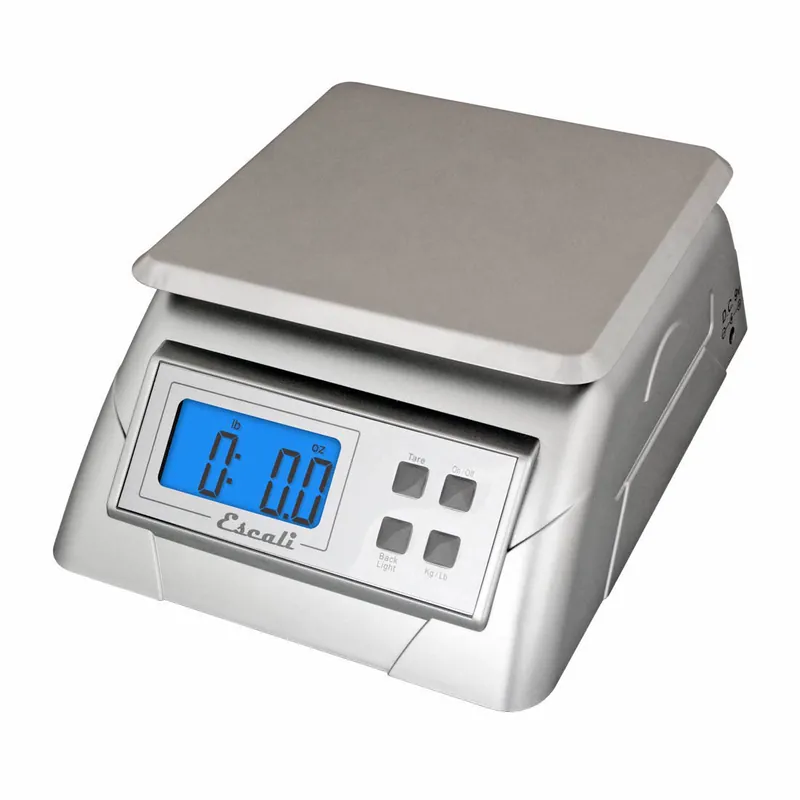
Display contrast matters too, especially under cabinet lighting. The Vera and Alimento have backlit displays, and the T115S uses a reverse LCD with white digits on a black background.
Glass, stainless steel or a sealed panel: what is easiest to keep clean?
Flour dust, batter and meat juices find every gap in a scale, and three styles of surface in our range deal with them differently.
Smooth glass with touch controls leaves nothing to trap crumbs. The ArtiXL, T115S and Nutro put their controls under a single glass surface, and the Arti has a tempered glass top. There are no button edges for dough to dry into.
Sealed control panels protect the electronics from liquids. The Primo, Telero and Vera seal their display and controls under a protective shield to guard against spills, and the Supernova is described as water resistant. That matters most when you weigh raw meat or anything that drips.
Removable parts let you wash the surface that touches food. The Vera's stainless steel plate comes off and goes in the dishwasher, and the Retro Classic's stainless steel bowl is removable and dishwasher safe as well. Our lab scales carry removable stainless steel tops.
Batteries, adapters or no power at all?
Most digital kitchen scales run on batteries and switch themselves off to save them, so check the auto-off time against how you work.
Our Primo turns off after four minutes of inactivity. The Vera, Arti, Telero, Pico, F115, T115S and Nutro wait five minutes. On the Alimento, the screen shuts off after 30 seconds of inactivity, and the Granda switches off after three minutes when it runs on batteries.
The Arti ships with two CR2032 coin cells, and the L600 lab scale comes with 4 AA batteries. For mains power, the Alimento is compatible with an AC power adapter, the Supernova takes an optional 9 V adaptor, and the M-Series runs on 4 C batteries or its included 9 V adapter.
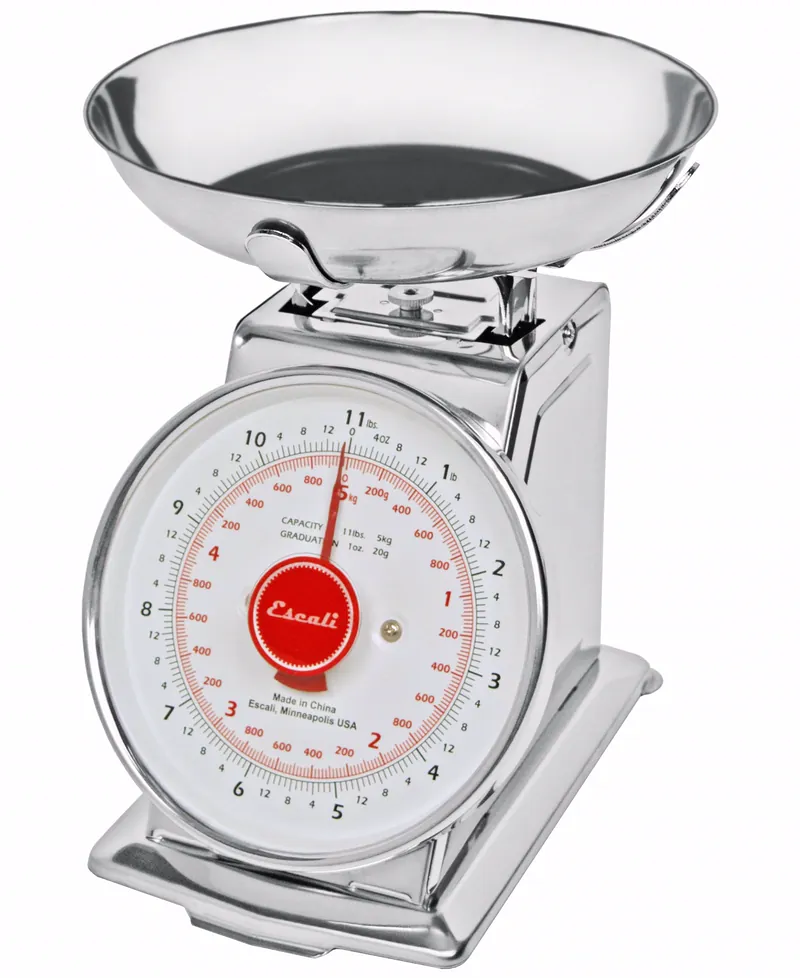
Then there is the scale that never needs power. The Retro Classic is a mechanical spring scale with a metal frame, a shatterproof dial in both lb:oz and kg:g, and a tare feature. It needs no batteries, so it keeps working through a power cut, at a cabin or on a back porch.
What does a food-service kitchen need from an Escali scale?
Commercial kitchens add requirements a home cook rarely meets. NSF, which has facilitated more than 75 standards and protocols for sanitary food equipment, explains on its food equipment standards page that these standards cover material safety, design, construction and product performance.
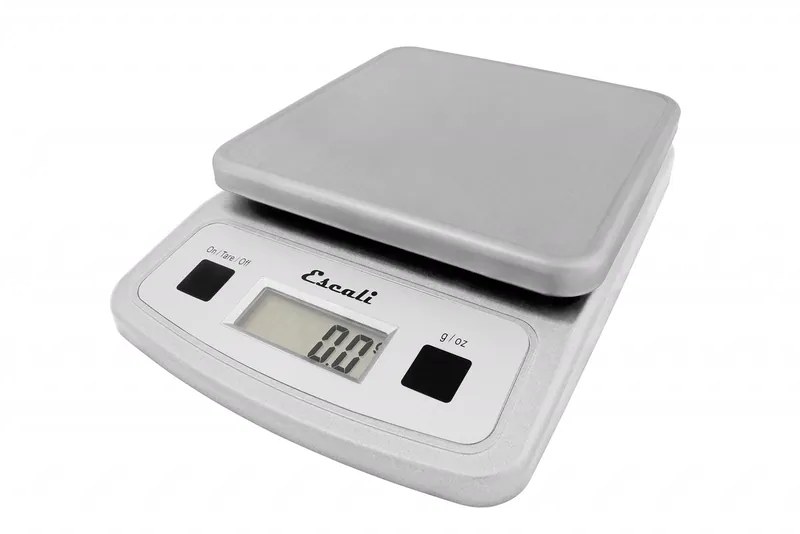
Our Supernova is NSF listed, water resistant and weighs up to 13 lb (6 kg), in steps as fine as 0.5 g. It runs on batteries or an optional 9 V adaptor and is priced at $109.57.
For heavier work, the M-Series is described as NSF certified and weighs from 10 g up to 30 kg (66 lb) in 2 g increments. Its display and buttons are sealed against spills and food debris, and screens on the front and back let two people read the same measurement. Tare, hold and parts counting round out a scale built for bakeries, breweries and restaurant kitchens.
When does a special scale make more sense?
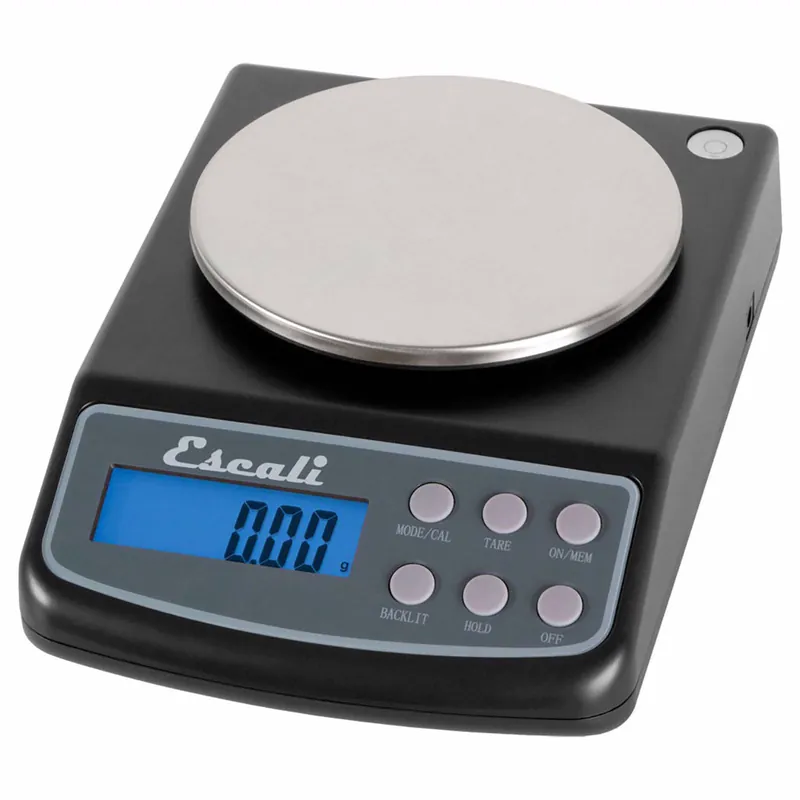
Precision work calls for a lab scale. The L125 reads to 0.01 g with a 125 g capacity and a removable stainless steel pan. Its bigger sibling, the L600, handles up to 600 g and measures in six units, including grams, ounces, grains, carats, pennyweights and troy ounces, with hold and tare. Both suit spices, hydrocolloids and coffee dosing.
Bulk weighing calls for a platform scale. The Granda has a stainless steel platform of 10.63 x 10.63 inches, a capacity of 120 kg and readings in 0.05 lb (0.02 kg) steps. Its backlit remote display hangs on a coiled cord, so you can read it while a crate or a sack of flour covers the platform.
Volume readings call for the Pana V136 and its ingredient codes, when you want to see what a cup of a given ingredient looks like on the platform. To see how a digital scale turns weight into a number, read our piece on how kitchen scale technology works.
Escali Supernova NSF Listed Scale
A water-resistant 13 lb scale for commercial kitchens, on batteries or an optional adapter.
Escali L125 Precision Lab Scale
A 125 g lab scale that reads in 0.01 g steps under a removable stainless top.
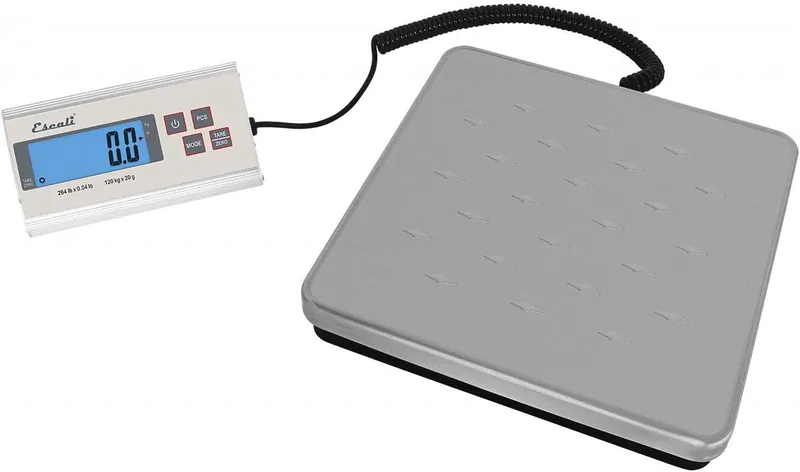
Escali Granda Platform Scale
A 264 lb stainless platform with a remote display on a coiled cord, for parcels and bulk goods.
How can you sanity-check a new scale at home?
Water makes a good everyday reference. NIST's kitchen tools page notes that water is about 1 g per mL, so 1,000 g of water is about 1 L. Measure water in a clear liquid measuring cup, then pour it into a tared bowl on the scale and compare the two numbers.
Read the cup carefully. The NIST measurement tips advise reading the meniscus of a fluid measuring cup on a level surface, at eye level. Repeat the test once or twice and look for readings that land close together, rather than expecting a perfect match to the gram.
Keep the conditions fair. Set the scale on a firm, level counter, wait for the display to settle at zero before adding anything and keep the load near the center of the platform. If the readings still wander, fit fresh batteries and run the test again before you draw conclusions.
The same water trick tells you how much a pan holds. NIST describes setting an empty pan on the scale, pressing tare and filling it to the rim with tap water. The grams give you the volume in milliliters.
Which Escali scale fits which job?
Most kitchens fit one of a few patterns, and each pattern points to a type of scale. Find your main tasks first, then compare the specific models on their cards.
| Job | What to look for | Escali scales that fit |
|---|---|---|
| Bread and big batches | High capacity with a heavy bowl counted | ArtiXL, Nutro, Arti |
| Everyday cooking and baking | 1 g steps, about 5 kg capacity, tare | Primo, Telero, T115S |
| Herbs, spices, yeast | Small capacity, removable plate | Vera PR2000S |
| Hydrocolloids, coffee, hobby work | 0.01 g steps | L125 |
| Thin liquids in fl oz or ml | Liquid units on the menu | F115, T115S, Nutro, Arti |
| Cups-only family recipes | Volume readings by ingredient code | Pana V136 |
| Wide bowls and oversized items | Display hold or an elevated platform | Alimento, Pico, Nutro |
| No batteries at all | Mechanical dial | Retro Classic |
| Restaurant and food service | NSF mark, sealed design | Supernova, M-Series |
| Crates, sacks and stock | Large platform with a remote display | Granda |
| Small storage space | Compact or folding body | F115, Pico |
If you bake and cook in equal measure, an 11 lb scale in 1 g steps such as the Primo at $25.00 covers most days, and a small high-precision scale beside it picks up the teaspoon amounts. Bread in big batches calls for more room, and the ArtiXL and its 22 lb capacity give you the most headroom.
Whatever you choose, give it a quick water test, learn its auto-off timing and keep it on a clear patch of counter where you can reach it. The kitchen models mentioned here sit in our kitchen scale range, and the lab and platform models wait under more scales.