
Technology · 11 min read · Updated November 15, 2026
Scale Manufacturing Innovations: EScali Technologies 2024
A scale and a thermometer both turn something you can't see, a load or a core temperature, into a number. How each Escali model does it, from spring dials to thermocouples, decides how you cook with it.
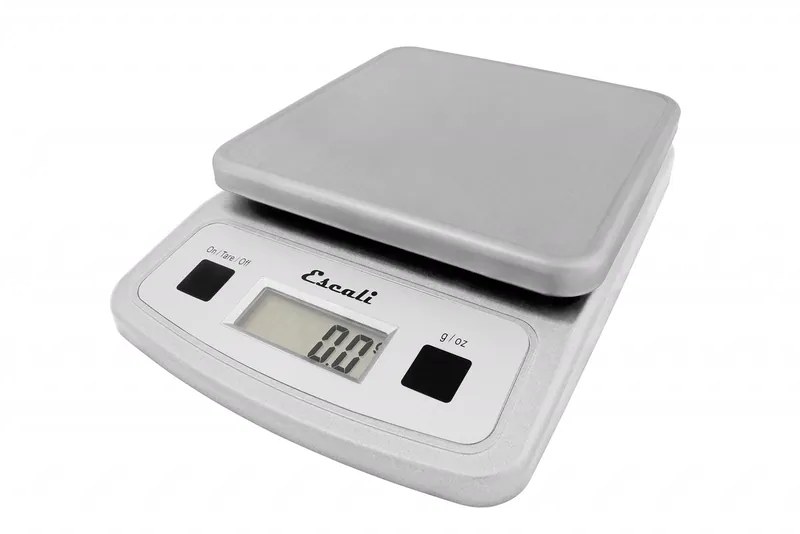
Every scale and thermometer in our range answers one of two questions for you: how much, or how hot. The answer reaches you through design choices that are easy to overlook at the counter. A spring or a sensor, a step of one gram or of a hundredth, a glass top or a steel plate, a battery or no battery at all. Each of those choices changes what the tool does well, and once you see them, picking the right one for the food you actually cook gets much simpler.
How does a scale turn weight into a number?
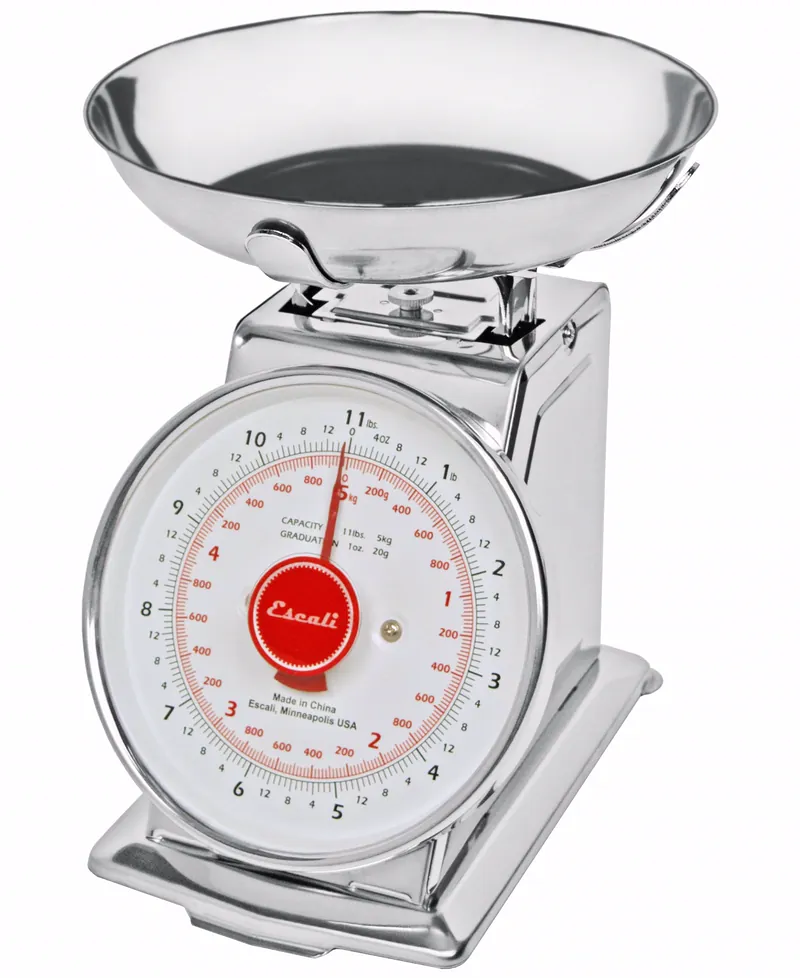
There are two ways to weigh in the current Escali line, and you can find both on our kitchen scale shelf. The older one is mechanical. In general terms, a spring scale lets the load stretch or compress a spring, and a linkage turns that small movement into the sweep of a pointer across a dial.
The Escali Retro Classic is built on that principle. Its description calls it a spring scale with a metal frame, a shatterproof dial marked in both lb:oz and kg:g, and a removable stainless steel bowl that goes in the dishwasher. It holds up to 11 lb. Because it needs no batteries, it keeps working in a pantry, a garage or a cabin where a flat coin cell would leave a digital scale blank.
The second way is electronic. Our descriptions speak of "precision weighing sensors" on the Arti and "precision sensors" on the Alimento. You don't need the parts list to picture the general idea behind an electronic platform. Something under the top flexes by a tiny amount when you set food on it, far too little to see. The electronics measure that change, compare it with the empty reading, and show the result as grams or ounces.
That design is what gives a digital scale its familiar habits. A printed number replaces your reading of a pointer, so two people in the same kitchen see the same value. Tare becomes a button you press between ingredients. Units become a choice: the Primo weighs in oz, lb:oz and g, while the Arti adds fluid ounces and milliliters for liquids. The cost of all this is a power source, and every electronic model has to manage its batteries.
So which way is better? Usually the job decides. The NIST Office of Weights and Measures recommends a digital kitchen scale for measuring recipe ingredients in grams, and a gram readout is far easier to repeat than a needle resting between two marks. A spring dial earns its place where power is the problem and fine steps don't matter.
What decides how fine an Escali scale can weigh?
Resolution is the size of the smallest step a scale can display. Across our range it runs from a hundredth of a gram on the lab scale to twenty grams on the platform scale, and capacity moves almost in step with it. The figures below come straight from each product's own description.
| Scale | Capacity | Smallest step | What it suits |
|---|---|---|---|
| L125 Precision Lab Scale | 125 g | 0.01 g | Very small amounts |
| Primo Digital Scale | 11 lb (5,000 g) | 1 g (0.05 oz) | Everyday cooking and baking |
| ArtiXL Glass Scale | 22 lb (10 kg) | 1 g | Big batches in heavy bowls |
| Supernova NSF Listed Scale | 13 lb (6 kg) | 0.5 g or 0.05 oz | Food service counters |
| M-Series Kitchen & Industrial Scale | 66 lb (30 kg) | 2 g | Restaurant kitchens, bakeries, breweries |
| Granda Platform Scale | 120 kg | 0.02 kg (0.05 lb) | Bulk goods and boxes |
Divide capacity by step and a pattern appears. The L125 counts about 12,500 steps across its range, the Primo 5,000, the M-Series 15,000 and the Granda 6,000. What changes from one scale to the next is how much each step is worth, and it grows with the load the scale was made to carry.
The reason is easy to grasp in general terms. A sensing element that can register a hundredth of a gram has to move noticeably under a very light load. Put a heavy pot of stock on that same element and it would be pushed far beyond what it was built for. A scale meant for heavy loads needs a stiffer element, and a stiffer element moves less for each added gram. Fine steps and big capacity pull in opposite directions.
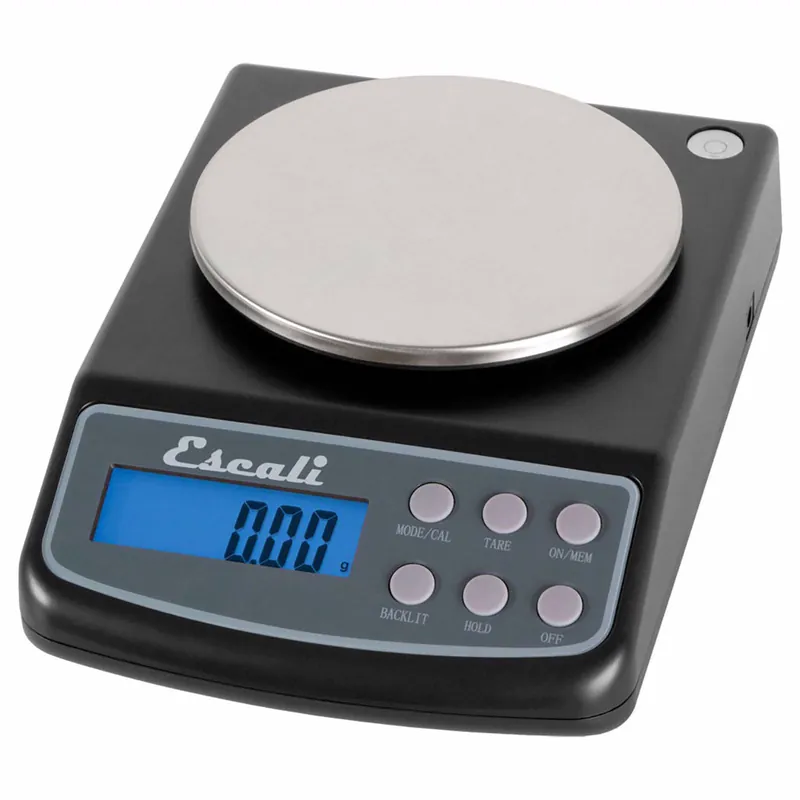
For your own kitchen, NIST offers a practical way to choose. It suggests thinking about the gross weight of your typical recipes, meaning the ingredients plus the bowl, and it names 5 kg as a common capacity for home cooking. That is exactly the 5,000 g of the Primo, at $25.00, which reads in 1 g steps like the Telero. NIST adds that a smaller-capacity scale is handy for small quantities such as herbs and spices. That is the work the Escali L125 does, at $151.36, and you will find it with the lab and platform models in our other scales. If you are still weighing up capacity against footprint and price, our guide to choosing a kitchen scale goes through those trade-offs one by one.
Why glass, steel or a sealed panel on Escali scales?
Kitchen scales live in the messiest spot on the counter. Flour drifts, batter drips and eggs crack right next to them, and the trouble always collects in the same places: the seams around the buttons and the gap under the display. Most of the material choices across our line exist to deal with that mess.
Glass is one answer. The Escali Arti, at $34.95, has a tempered glass top over its precision weighing sensors and a touch-sensitive screen. It weighs up to 15 pounds, measures 9 x 6.5 x 0.75 inches and weighs 0.3 pounds itself, so it slides into a drawer when you are done. The ArtiXL takes the idea further with a smooth glass surface that resists stains and touch controls that won't trap dirt. On the T115S and the Nutro, the touch controls form a single smooth glass surface, so there is no button edge to collect crumbs.
Stainless steel is the other answer, and it brings a different benefit. The Vera has a removable stainless steel plate that is dishwasher safe, which means the part that touches food comes off and gets a proper wash. The Escali Alimento raises its stainless platform above the body, so a large bowl or plate sits high and doesn't hide the screen.
Sealing handles what gets past the surface. On the Primo, the display and controls are sealed under a protective shield to guard against accidental spills, and the rounded body is easy to wipe. The Telero's sealed control panel helps keep liquids and food out of the housing. The M-Series goes furthest for heavy use, with a sealed display and buttons against spills, food debris and liquids, plus adjustable leveling feet. The Supernova is described as water resistant.
None of that makes a scale a mixing station, though. NIST advises you not to mix ingredients while the bowl sits on the scale, and to move the bowl to a stable surface first so you don't damage the scale. A sealed panel protects against splashes, not against a whisk pounding the platform.
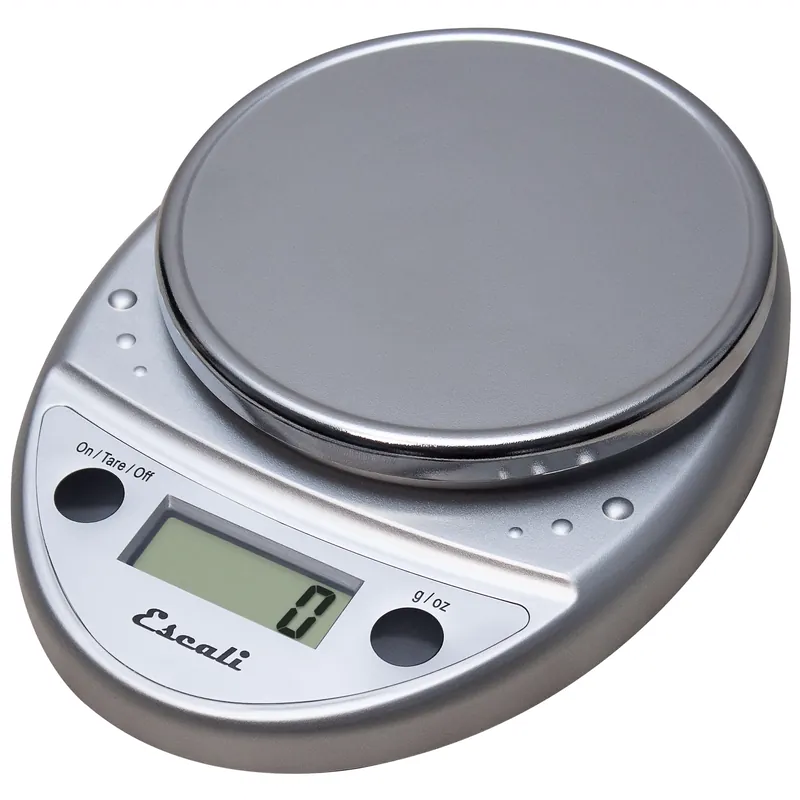
Escali Primo Digital Food Scale
A sealed two-button scale with a rounded body that wipes clean, weighing up to 11 lb in 1 g steps.
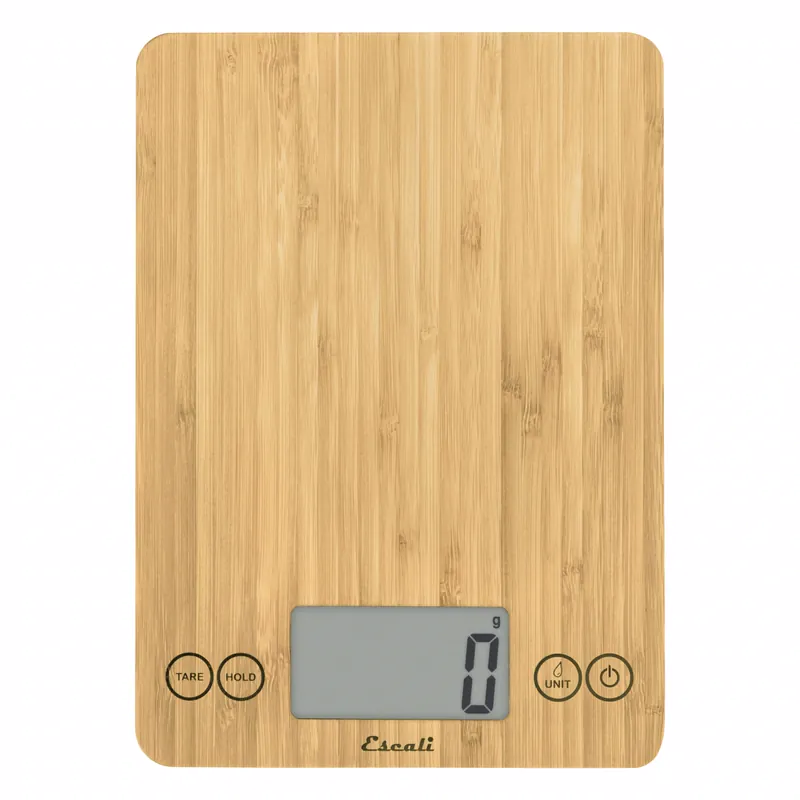
Escali Arti Glass Food Scale
A tempered glass top with a large touch screen that keeps the reading on display after you lift the bowl.
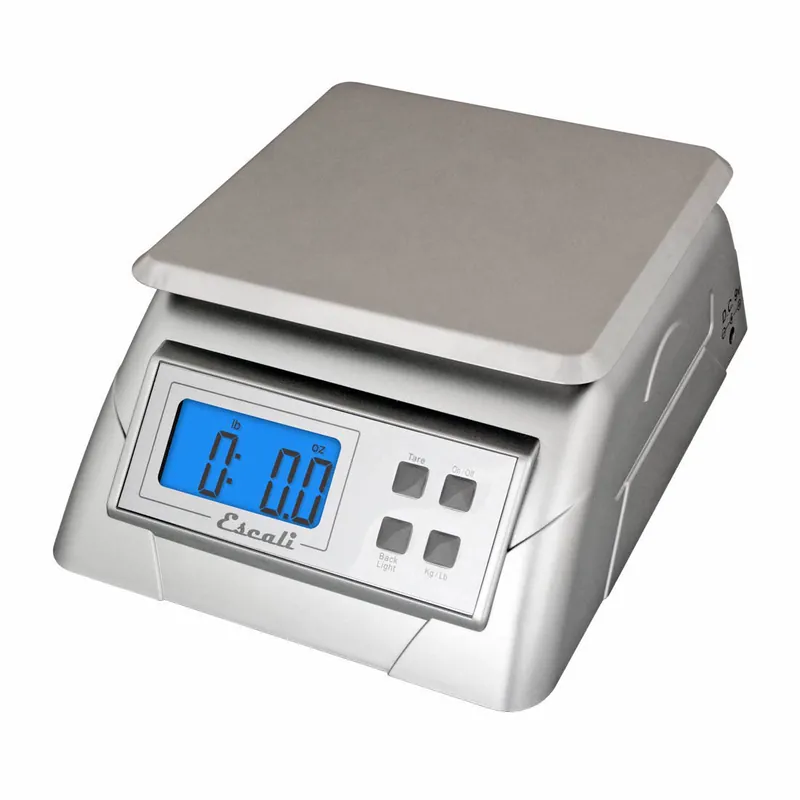
Escali Alimento 136DK
Smart scales with mobile app connectivity. Nutrition tracking and automatic calorie calculation.
How do the displays stay readable?
A reading only helps if you can see it from where you are standing. Several of our scales add a backlight, among them the Vera, the Alimento and the Granda, whose light behind the LCD makes numbers easier to read in low light. The T115S uses a reverse LCD with white digits on a black background, a high-contrast look the Compact bathroom scale shares.
Big items create a second problem, because they cover the screen. Display hold solves it by keeping the weight on screen after you lift the item away, and you get it on the Arti, the Pico and the Nutro. The Granda moves the screen off the scale altogether, with a remote display on a coiled cord, so a large box on the platform can't block it. The M-Series shows its reading twice, on front and rear screens, so you and someone across the prep table can read it at once.
Where does the battery power go?
A digital scale draws power only while it is awake, so most of ours put themselves to sleep. The Primo turns off after four minutes of inactivity. The Vera, Pico, F115, T115S, Nutro, Arti and Telero wait five minutes, and the Granda turns off after three minutes when it runs on batteries. The Alimento takes a lighter touch: it shuts the screen off after 30 seconds of inactivity rather than the whole scale.
Those timers are a trade. A short one saves the batteries, while a long one forgives you for wandering off to find the vanilla. On the Granda, you can also place your container on the platform before you switch it on, and the scale subtracts its weight automatically.
Some scales offer other power choices. The M-Series runs on 4 C batteries or its included 9V AC adapter. The Supernova works on batteries or an optional 9-volt adaptor, and the Alimento is AC adapter compatible. At the other end, the Retro Classic needs no power at all, and among our bathroom scales the Kinetic is powered by kinetic energy, with a low power indicator that tells you when the charge is about to end.
What do bathroom and platform scales add?
Body weight scales share the same building blocks with a different focus. They have to wake up the moment you step on, carry a much larger load and stay steady under bare feet. Every bathroom scale in our bathroom, lab and platform range uses Instant On, which turns the scale on the instant you step onto the platform.
Capacity is set for people rather than flour. The ComfortStep, Compact and Extra Wide models handle 400 lb (180 kg), and the High Capacity model handles 562 lb. Surfaces differ too. The ComfortStep has a removable linen cover that is slip resistant and warmer underfoot than standard glass, the High Capacity model has an anti-slip surface, and the Extra Wide platform gives you a wider, more natural stance. The Compact and Extra Wide keep the reading on screen for 10 seconds after it first appears, which helps if you can't see the display easily while standing on it.
What does "NSF listed" mean on the Escali Supernova?
When a scale moves from a home kitchen into food service, cleanability becomes part of the job. NSF has facilitated more than 75 standards and protocols for sanitary food equipment, according to its page on food equipment standards. It has certified thousands of products for restaurant and commercial kitchen use.
Those standards include requirements for material safety, design, construction and product performance. In plain terms, they look at the materials that touch food and at shapes that either clean easily or trap debris, the same weak points a home cook fights with a damp cloth.
Our Escali Supernova, at $109.57, is an NSF listed digital scale with a 13 lb (6 kg) capacity. It is water resistant, weighs in oz, lb+oz, lb and g, and reads in steps of 0.05 oz, 0.1 oz, 0.5 g or 1 g. The M-Series also describes itself as NSF certified, alongside its sealed spill-proof design.
How fast should a thermometer read, and why does the sensor matter?
Thermometers follow the same logic as scales: the sensing method sets the speed and the limits. The USDA Food Safety and Inspection Service sorts food thermometers by type, with a typical reading time and a minimum depth for each one.
| Type (USDA) | Typical reading time | Minimum depth in food | Stays in food while cooking? | Escali match |
|---|---|---|---|---|
| Thermocouple | 2 to 5 seconds | 1/4 inch or deeper | No | Stelo, thermocouple sensor |
| Thermistor | About 10 seconds | At least 1/2 inch | No | Sensor type not stated for our other digital models |
| Oven cord (probe) | About 10 seconds | At least 1/2 inch | Yes, base on the counter | DHR1 with oven-safe probe and cord |
| Oven-safe bimetal dial | 1 to 2 minutes | 2 to 2 1/2 inches | Yes, not for thin foods | AH1 oven-safe dial |
| Instant-read bimetal dial | 15 to 20 seconds | 2 to 2 1/2 inches | No | AH2 instant-read dial |
| Liquid-filled | 1 to 2 minutes | At least 2 inches | Yes | None |
The depth column matters as much as the speed. A thermocouple needs only 1/4 inch, so it can read a thin burger. An instant-read dial averages the temperature along 2 to 3 inches of stem, which suits a roast and struggles with a cutlet. Our guide to using a meat thermometer covers where the tip belongs in each kind of food.
The Escali Stelo, at $69.95, is the one model in our line whose description names its sensor. It uses thermocouple technology and gives readings in under a second, faster than the general USDA range for the type. It also folds, with a 1.6 mm step-down tip that measures at any angle between 45° and 180°, and it runs on a rechargeable lithium-ion battery with an auto-off feature.
Probe shape adds speed of its own. A step-down tip narrows the metal at the point, and our descriptions say this design is meant for quicker measurements. The Escali DHP3, at $21.95, has a 1.8 mm step-down tip and reads in about 4 seconds. The DH6 uses a 1.7 mm tip and reads in as little as 4 seconds, while the Long Stem model's 1.8 mm tip gives a reading within 6 seconds. Their sensor type isn't stated, so we don't place them in a USDA category.
Durability belongs to the same picture. The DHP3 and the Stelo carry an IPX7 waterproof rating, built for splashes and rinsing. Dial thermometers trade speed for simplicity: the AH2 instant-read dial, at $9.95, has a magnified shatterproof lens and goes in the dishwasher.
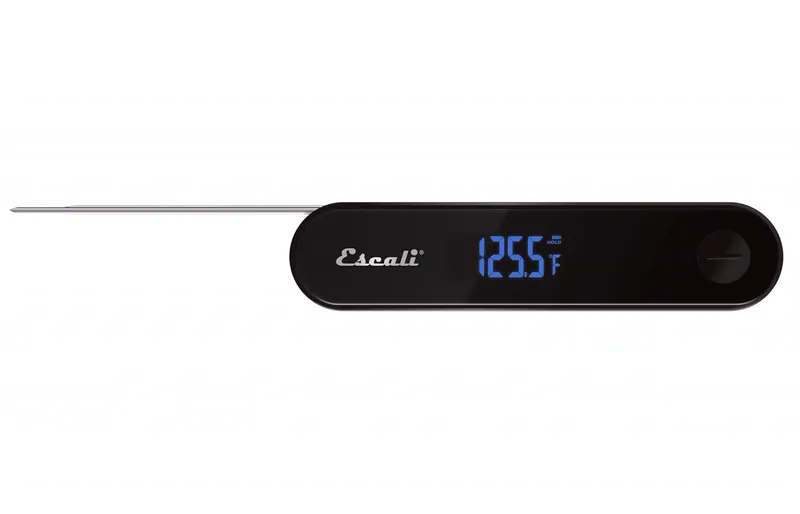
Escali Stelo Rechargeable Thermometer
Thermocouple readings in under a second, a display that turns for either hand and a rechargeable battery.
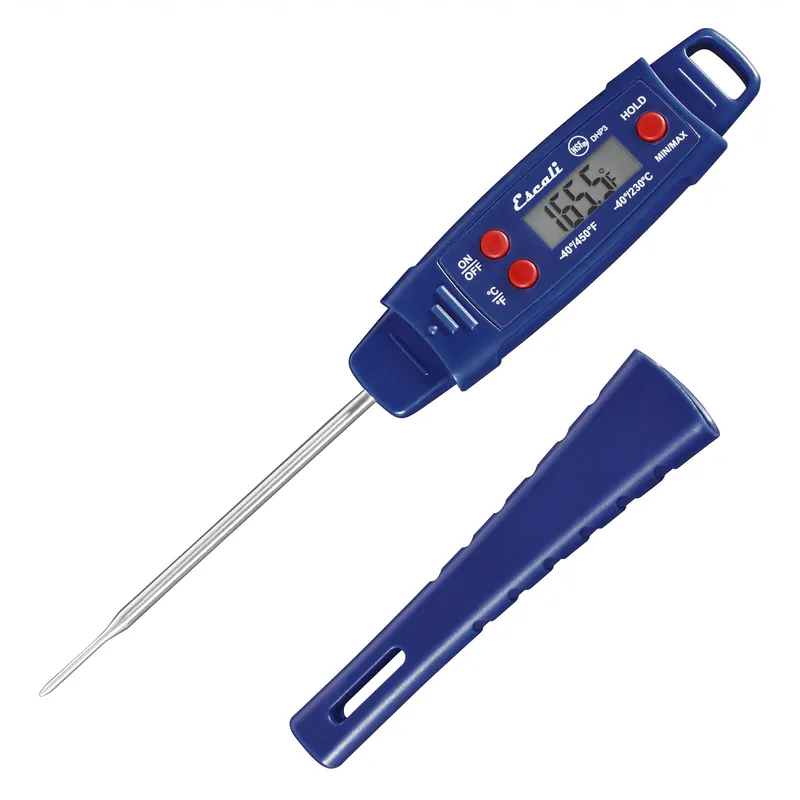
Escali DHP3 Waterproof Meat Thermometer
Reads in about four seconds through a 1.8 mm tip and rinses under the tap, rated IPX7.
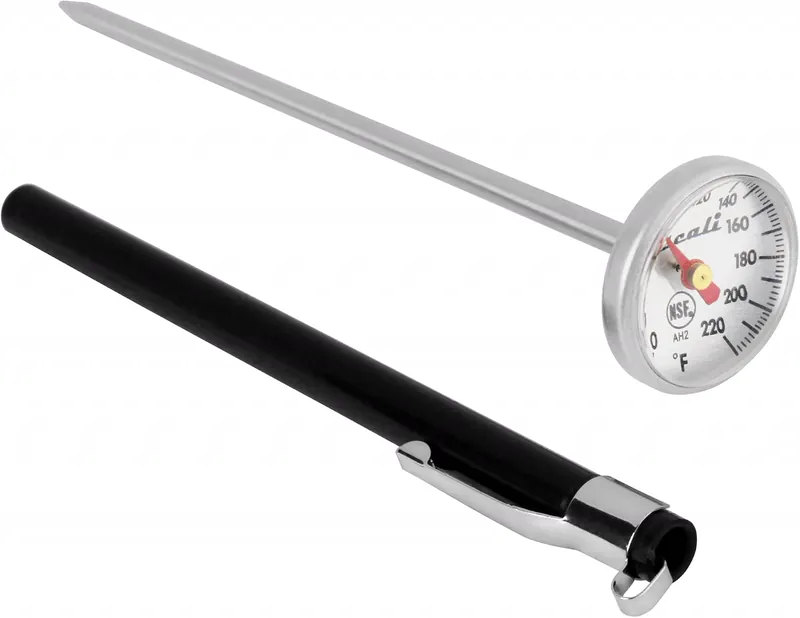
Escali AH2 Instant-Read Dial Thermometer
A 1-inch dial under a magnifying, shatterproof lens, on a 5-inch probe with a pocket sheath.
Why test an Escali thermometer in ice water and boiling water?
No sensor stays perfect forever, and the USDA notes that most food thermometers read accurately within 2 to 4 °F, but only if they are placed correctly. Two checks tell you where yours stands. For the ice-water check, which the USDA calls best for most thermometers, fill a glass with ice, add drinking water and stir. Hold the stem at least 2 inches in without touching the sides or bottom, wait at least 30 seconds, and look for 32 °F.
The boiling-water check uses the other end of the scale. At sea level, a stem held at least 2 inches into boiling water should read 212 °F after at least 30 seconds. NIST describes the same idea from the metric side, evaluating a cooking thermometer in boiling water at 100 °C at sea level, reading the displayed value and adjusting by the difference. At high altitude, the USDA says water boils lower, likely at least 2 °F and as much as 5 °F lower, so ask your local Cooperative Extension office for the exact figure.
Range decides which checks a thermometer can take. The AH2 covers 0 °F to 220 °F, so both test points fit on its dial. The AH1 oven-safe dial reads from 140 °F to 190 °F, which leaves both points off its face. Cold-storage thermometers need the ice point most of all, and our piece on fridge and freezer temperatures shows how to check them where they live.
You can compare every thermometer mentioned here, with current prices, in our thermometer range.