
Molecular Cuisine · 11 min read · Updated November 15, 2026
Molecular Gastronomy at Home: Precision as the Foundation of Creativity
Spherification turns a flavored liquid into soft gel beads with a thin skin. The chemistry runs on fractions of a gram, so the scale you weigh with decides whether the beads form the way the ratio says.
A spoonful of juice that holds its shape as a trembling bead, then bursts on the tongue, looks like a restaurant trick. At home it comes down to two powders, two bowls of liquid and a couple of numbers you have to hit. The numbers are small. A batch of flavored liquid sized for a dinner party may call for a gram and a half of sodium alginate, and a kitchen scale that counts in whole grams cannot show that amount. Precise weighing is what lets the creative part work.
What is spherification?
The HarvardX Science and Cooking course describes basic, or direct, spherification in a short spherification handout. You dissolve sodium alginate into a flavored liquid at 0.5%, which works out to 0.5 g per 100 g of liquid. Then you drip that liquid into a bath of water with calcium dissolved in it. Where a drop meets the calcium, the alginate sets into a gel, and the drop gets a thin skin around a liquid center.
Sodium alginate comes from brown algae. The federal rule that covers it, 21 CFR 184.1724, describes it as the sodium salt of alginic acid, a constituent of certain brown algae, and affirms it as generally recognized as safe within specific limits of use. Those limits come up again further down.
Basic or reverse: which one do you need?
The handout separates the two methods by what your flavored liquid already contains. In basic spherification the alginate goes into the flavored liquid and the calcium sits in the bath. That only works when the liquid has no free calcium ions of its own, because calcium already in the liquid would react with the alginate before you ever drip it. For ingredients that contain calcium, the handout points you to reverse spherification. There the calcium-containing liquid is dripped into an alginate bath instead. Reverse is also the route for liquids that are high in acid or alcohol.
The choice shapes your shopping list. According to the handout, calcium chloride is the preferred bath salt for basic spherification, and calcium lactate gluconate is preferred for reverse, since it has no discernible flavor. Pick the method first, then buy the salt.
How much sodium alginate goes into a batch?
The rule is a single ratio: 0.5 g of sodium alginate for every 100 g of flavored liquid. Everything else is multiplication. Weigh your liquid, divide by 100, multiply by 0.5, and you have the alginate. A 300 g batch needs 1.5 g. A 250 g batch needs 1.25 g, and a 500 g batch needs 2.5 g.
Weigh the liquid in grams rather than pouring it into a cup, so the number you multiply is a real mass. NIST's culinary measurement tips call measuring by mass with an appropriate kitchen scale a best practice for recipe accuracy. In a cake that advice improves the crumb. Here the whole method hangs on it, because every other dose is calculated from that one weight.
| Weight of liquid or bath water | Sodium alginate in the flavored liquid (0.5%) | Calcium chloride in the bath (0.5%) | Calcium lactate in the bath (1%) | Calcium lactate gluconate in the bath (2%) |
|---|---|---|---|---|
| 100 g | 0.50 g | 0.50 g | 1.0 g | 2.0 g |
| 250 g | 1.25 g | 1.25 g | 2.5 g | 5.0 g |
| 300 g | 1.50 g | 1.50 g | 3.0 g | 6.0 g |
| 500 g | 2.50 g | 2.50 g | 5.0 g | 10.0 g |
| 1,000 g | 5.00 g | 5.00 g | 10.0 g | 20.0 g |
Read across the row that matches the weight on your display. If your flavored liquid weighs 300 g, the alginate column says 1.50 g. If your bath water weighs 1,000 g and you use calcium chloride, the bath needs 5.00 g. The two weights do not have to match, since the liquid and the bath live in separate bowls.
Why can't a 1 g kitchen scale read 1.5 g?
A kitchen scale that counts in whole grams rounds every reading to the nearest gram. Put 1.5 g of powder on it and the display shows 1 or 2. One gram is a third less alginate than the batch needs, and two grams is a third more. On a cake that rounding disappears into the batter. In a spherification liquid it shifts the concentration you are relying on, and the 0.5 g needed for a 100 g test batch can show up as zero.
Some kitchen scales also have a floor. Our Telero states a weighing range of 5 grams to 13.2 pounds, so a small heap of powder below 5 g sits outside the range it is built for. That is not a flaw for its job, which is bowls of batter and big recipes. It simply shows that a kitchen scale and a powder scale do different work.
Which Escali scale weighs the powders?
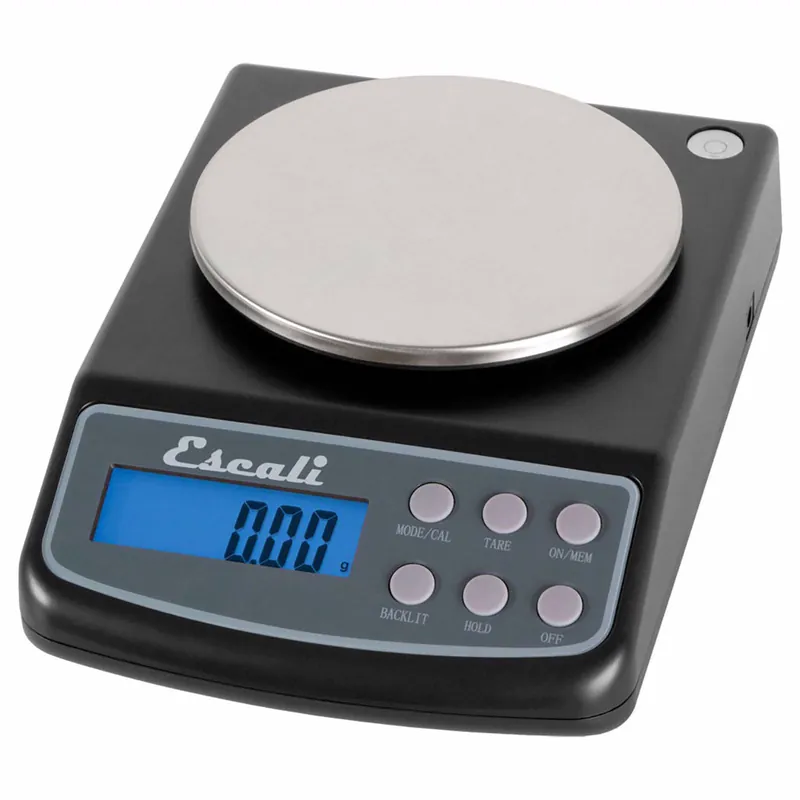
A lab scale with 0.01 g steps closes the gap. The L125 precision lab scale has a 125 g capacity, reads in 0.01 g increments and comes with a removable stainless steel top. On it, 1.50 g shows as 1.50 and 1.25 g shows as 1.25, so the table above becomes something you can actually hit. NIST's page on kitchen cookware and tools notes that a smaller-capacity scale is handy for small quantities such as herbs and spices. Spherification powders are exactly that kind of quantity.
If you are still weighing up which type of scale suits your cooking, our guide on how to choose a kitchen scale looks at capacity and increments side by side. For spherification the answer is usually both: a fine scale for the powders and a larger one for the liquids.
Which calcium salt belongs in the bath?
The handout sets a target of 0.18% calcium in the bath and gives three salts that reach it. Their doses differ because each salt carries a different share of calcium by weight.
| Calcium salt | Calcium content | Dose in the bath | Grams per 100 g of water | Notes from the handout |
|---|---|---|---|---|
| Calcium chloride | 36.1% | 0.5% | 0.5 g | Preferred for basic spherification. Tastes salty, so rinse it off. Very hygroscopic, so keep the container closed and dry. |
| Calcium lactate | 18.4% | 1% | 1 g | Twice the dose of calcium chloride, since it carries about half the calcium. |
| Calcium lactate gluconate | 9.3% | 2% | 2 g | Preferred for reverse spherification. No discernible flavor. |
You can check the arithmetic yourself. Half a percent of a salt that is 36.1% calcium gives about 0.18% calcium in the water. One percent of a salt at 18.4% lands close to the same figure, and so does two percent of a salt at 9.3%. Three different salts, one target, and three different weights on the scale.
Calcium chloride asks for a little care. The handout says it tastes salty, so the spheres get a rinse in plain water after the bath. It is also very hygroscopic, which means it draws moisture from the air. Keep the container closed and dry between batches, and close it again as soon as you have weighed what you need.
How do you prepare the alginate liquid?
Get the liquid right before it ever meets the bath. The handout lists a handful of conditions, and each one is easy to miss when you are focused on flavor.
Keep it cold. The alginate should disperse through the liquid before it hydrates, and a cold liquid gives it time to spread out. Pre-mixing the weighed alginate with sugar also helps the powder disperse instead of clumping on contact.
Check the acidity. The pH of the liquid must be above 3.6. If yours is more acidic, the handout says you can reduce the acidity with sodium citrate before adding the alginate. Order matters here: citrate first, alginate second. A pH strip or meter tells you which side of 3.6 you are on, so you are not guessing from taste.
Watch for calcium and alcohol. A liquid for basic spherification cannot contain free calcium ions, and alginate does not hydrate well in alcohol. Thick purees often need thinning before they drip properly. The handout recommends distilled water for that job, because tap water usually contains calcium.
Then let it rest. Mixing traps air bubbles in the liquid, and the handout says to rest it in the fridge to remove them. Plan on about 1 hour for watery liquids, and anywhere from 1 to 24 hours depending on how dense the liquid is. A fine sieve or a vacuum chamber speeds this up.
How does an Escali thermometer help with a cold liquid?
The handout asks for a cold liquid but does not name a temperature. A probe thermometer still earns its place on the counter, because it lets you write down the temperature of a batch that worked and match it next time. Our DHP3 waterproof thermometer measures from -58°F to 572°F, gives readings in about 4 seconds and carries an IPX7 waterproof rating, so rinsing sticky alginate off the probe is no trouble. The DH1 Gourmet has an extra-long probe with a step-down tip, which gives you extended reach into a tall container of resting liquid.
Before you trust any thermometer with notes you plan to reuse, check its calibration. USDA's food thermometer guidance describes the ice-water test. Fill a glass with ice, add drinking water and stir, then hold the stem at least 2 inches in without touching the sides or bottom. Wait at least 30 seconds, and the reading should be 32 °F. Our meat thermometer guide covers the same test along with the boiling-water method.
Escali L125 Precision Lab Scale
A 125 g lab scale that reads in 0.01 g steps under a removable stainless top.
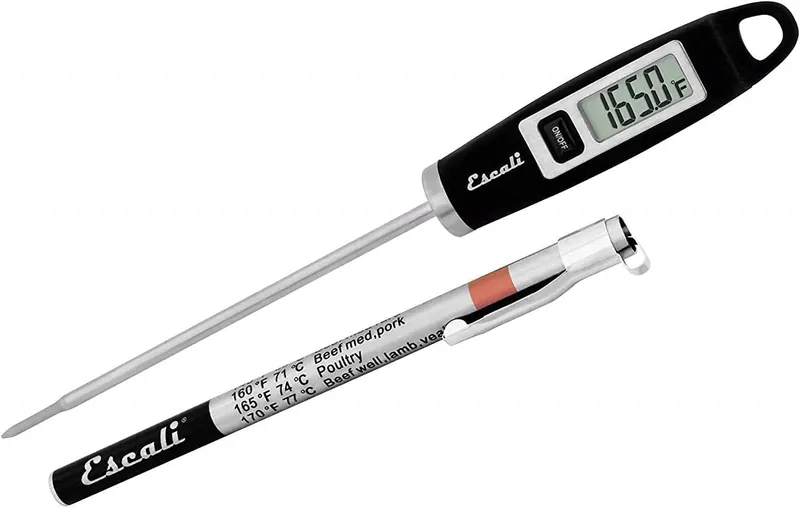
Escali DH1 Gourmet Digital Thermometer
A long step-down probe for roasts and bread, with a sheath that clips to a pocket and lists target temperatures.
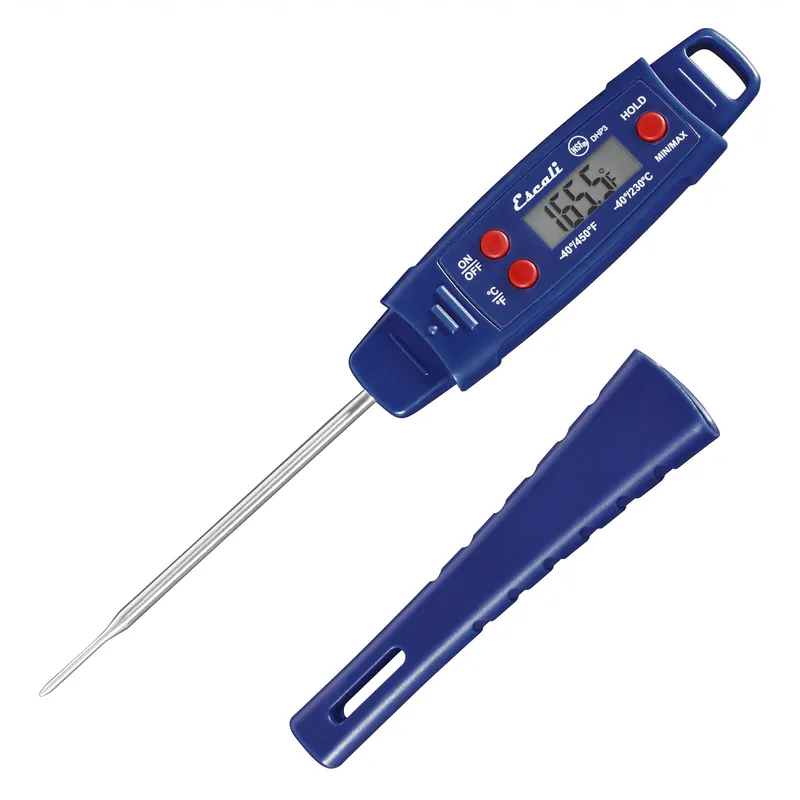
Escali DHP3 Waterproof Meat Thermometer
Reads in about four seconds through a 1.8 mm tip and rinses under the tap, rated IPX7.
How do you set up the Escali two-scale workflow?
Two scales split the work cleanly. The lab scale handles anything measured in fractions of a gram, and the kitchen scale handles the flavored liquid and the bath water. With both on the same counter, you never ask one scale to do the other's job.
- Put a small dish on the L125, press tare, and weigh the sodium alginate to the hundredth of a gram from the dosing table.
- Tare again with a fresh dish and weigh the calcium salt the same way.
- On the kitchen scale, set the bowl for the flavored liquid in place, press tare, and pour until you reach the batch weight.
- Lift that bowl off the scale before you whisk in the alginate.
- Set a second bowl on the kitchen scale, tare, and weigh the bath water.
- Lift the second bowl off too, then stir in the calcium salt.
Two NIST habits run through those steps. First, press zero before each new measurement, so the container and anything already weighed drop out of the reading. Second, do not mix while the bowl sits on the scale. NIST's cookware and tools page says to move the bowl to a stable surface first, to avoid damaging the scale.
Capacity decides which kitchen scale suits your batches. The Primo holds 11 lb (5,000 g), reads in 0.05 oz (1 g) increments and keeps its controls under a sealed panel that guards against spills. The Telero takes 13.2 pounds (6,000 g) on a large platform, so the display stays visible under a wide bowl. The ArtiXL goes up to 22 lb (10 kg) with 1 g increments and a smooth glass surface that wipes clean. Any of them carries a 1,000 g bath with plenty of room left for the bowl.
Keep the L125 for the powders alone. Its 125 g capacity covers a light dish plus a few grams of salt, while a bowl of liquid would go far past it.
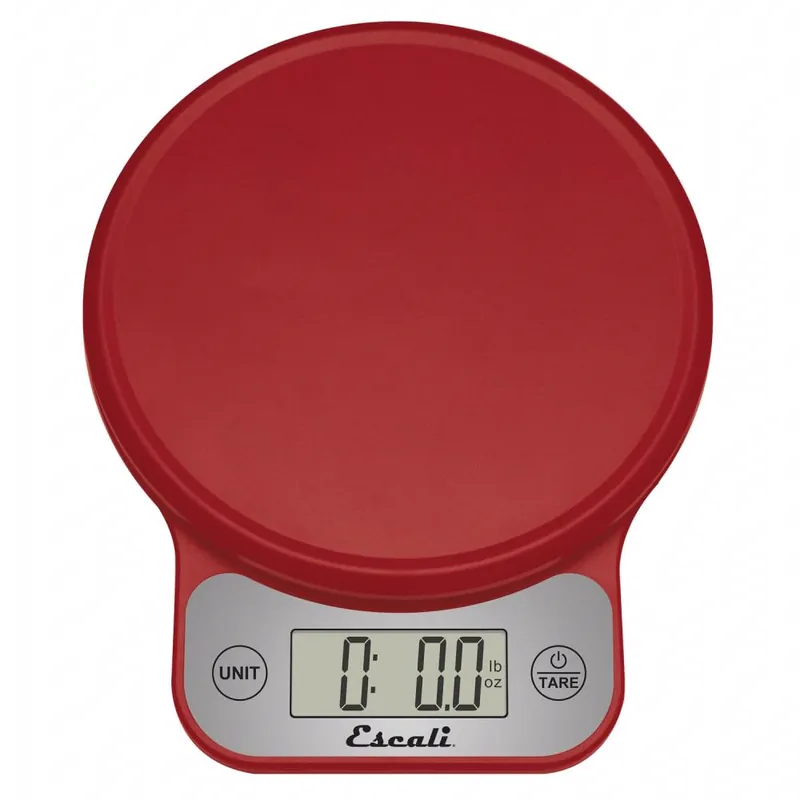
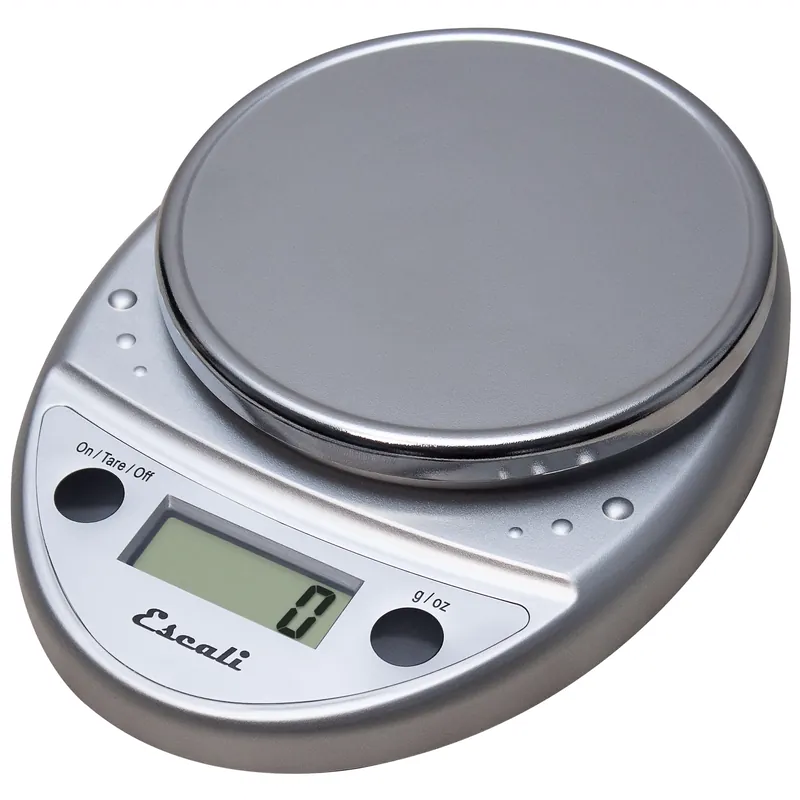
Escali Primo Digital Food Scale
A sealed two-button scale with a rounded body that wipes clean, weighing up to 11 lb in 1 g steps.
Escali Telero Food Scale
A broad platform keeps the display readable under a large mixing bowl, and the sealed panel keeps flour and liquid out.
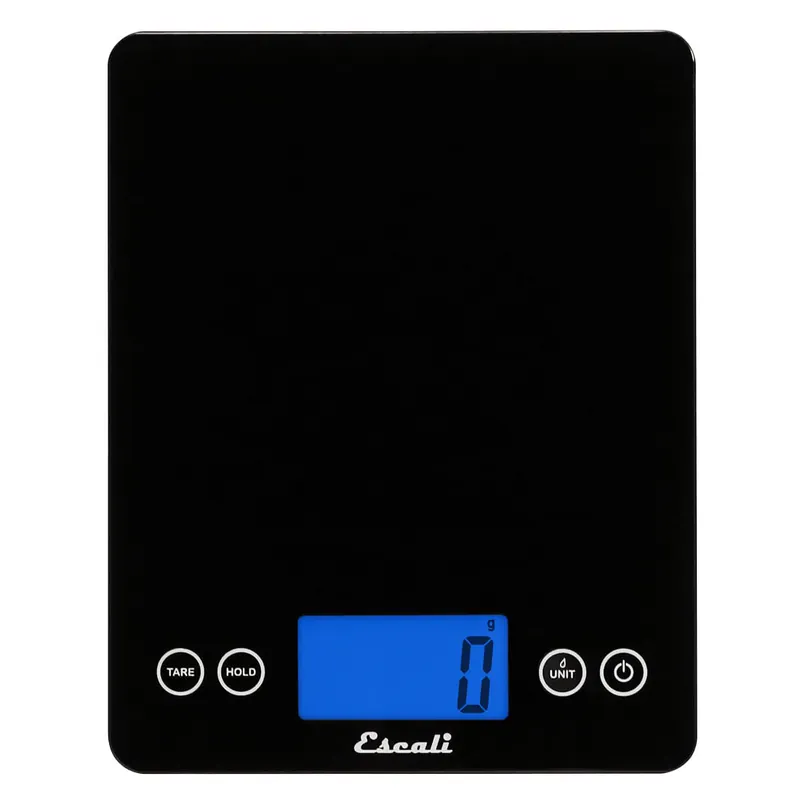
Escali ArtiXL Glass Scale
An extra-large glass platform that takes 22 lb in 1 g steps, with touch controls that wipe clean.
How do you drip, set and serve the spheres?
With the liquid rested and the bath stirred, the forming itself takes only minutes. Fill a syringe with the alginate liquid and hold it about 3 inches above the bath, as the handout suggests. Let it fall drop by drop for caviar. For large spheres, fill a measuring spoon and flip it gently over the bath.
Time decides the skin. Caviar needs about 1 minute in the bath, and large spheres about 2 minutes. Leave them in longer and the gel grows thicker. Lift them out and rinse them in plain water, which also takes away the salty taste of calcium chloride.
Serve basic spheres right away. The handout notes that gelling continues after they leave the bath, so a bead that is liquid inside now keeps firming toward its center. Plan the plating before you start dripping, not after the first spoonful is already setting.
If your spheres flatten in the bowl, make the bath denser. The handout says you can add up to 20% sugar to the bath so the spheres hold their round shape. Weigh that sugar along with everything else and note it in your log, so the next bath matches the one that worked.
What are the federal limits on sodium alginate?
Sodium alginate is affirmed as GRAS within specific limitations, and 21 CFR 184.1724 sets maximum levels of use in food as served. The categories differ widely, from 0.3% for confections to 10.0% for hard candy.
| Food category | Maximum level |
|---|---|
| Condiments and relishes | 1.0% |
| Confections and frostings | 0.3% |
| Gelatins and puddings | 4.0% |
| Hard candy | 10.0% |
| Processed fruits and fruit juices | 2.0% |
| All other food categories | 1.0% |
The handout's 0.5% solution sits below the 1.0% level listed for all other food categories, and below the 2.0% level for processed fruits and fruit juices. It sits above the 0.3% listed for confections and frostings, so one number does not fit every use. Treat the table as context for what the regulation says, not as a recipe.
Accurate weighing is how you know where your own batch stands. In a 300 g liquid, 1.50 g of alginate is 0.5%, while 3.00 g would already be 1.0%. Doubling the powder by accident is easy on a scale that rounds to the gram, and on a 0.01 g scale it is plain to see.
What does precision buy you in creative cooking?
Molecular cooking looks like improvisation, yet the improvising happens on top of fixed ratios. Once your alginate and calcium sit at the right weights, you are free to change the flavor, the color, the size of the spheres and the way you plate them. Every experiment then teaches you something, because the base stayed the same. Change two things at once with a guessed gram of powder and you cannot tell which change mattered.
Write every batch down by weight: the liquid, the alginate, the bath water, the salt, the rest time and the minutes in the bath. That log works like the margin notes in our guide to baking by weight, where a note such as "20 g more water" means the same thing every time you read it. Bakers already think in ratios of this kind, and the same percentage habit runs through our baking secrets by weight.
Our lab scales sit in the lab and platform scale section, next to the bathroom and platform models, and our kitchen scales fill the kitchen scale range. Pair one fine scale with one kitchen scale, weigh the powders to the hundredth and the liquids to the gram, and the bead in your spoon will form the way the ratio says it should.